Every Coding Agent Shipped the Same Feature in Two Weeks
Between April 30 and May 12, six platforms shipped autonomous coding primitives. What the convergence means for teams buying AI tooling.
By Springvanta
Between April 30 and May 12, six platforms shipped autonomous coding primitives in near-lockstep. Codex added /goal. Claude Code added /goal and Agent View. Cursor shipped Build in Parallel. GitHub Copilot launched a Max plan with $200/month in included usage. JetBrains brought Junie agents into Visual Studio. Xcode added agent clarifying questions. The specific features differ, but the direction does not: every major coding surface now assumes the developer will sometimes walk away and let the agent finish on its own.
This is not a coincidence. It is the latest sign that the market has settled on a shared thesis about how software gets built.
The fourteen-day convergence
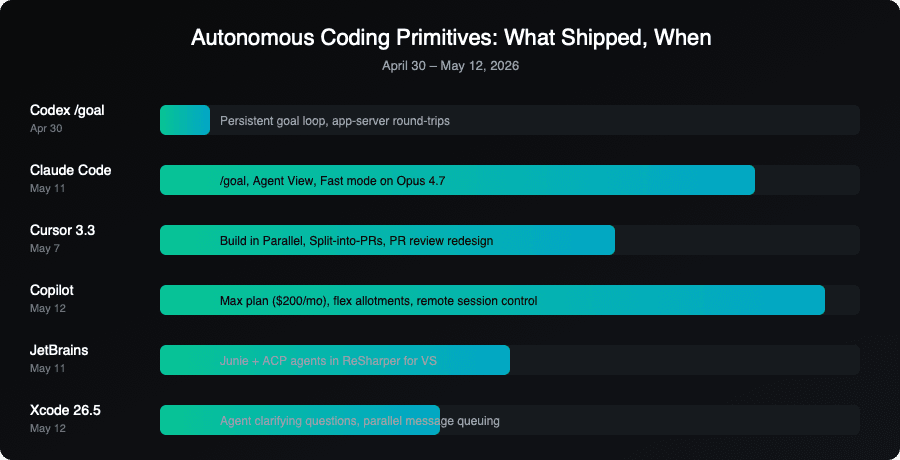
OpenAI shipped Codex CLI v0.128 on April 30 with a persistent /goal command that keeps the agent looping until a verifiable condition is met or the token budget runs out. The implementation round-trips through an app-server, which means goals survive terminal restarts. It is, as Greg Brockman put it on X, a built-in Ralph loop.
Eleven days later, Anthropic shipped Claude Code v2.1.139 with its own /goal plus Agent View, a single dashboard that shows every background session running across all your projects. Claude Code's /goal is session-scoped rather than server-persisted, but the intent is the same: describe an outcome, set the agent running, and check back when it finishes. Fast mode on Opus 4.7 shipped the same week, making long autonomous runs more affordable.
In between, Cursor 3.3 added Build in Parallel and Split-into-PRs, surface-level quick actions that dispatch autonomous agents from the editor rather than the terminal. GitHub Copilot announced a Max plan at $100/month with $200 in included usage, flex allotments for Pro and Pro+, and remote session control that lets you drive a local Copilot session from your phone or browser. JetBrains shipped ReSharper 2026.2 EAP with Junie agents and ACP integration inside Visual Studio. And Xcode 26.5 added two Coding Intelligence features: parallel message queuing so developers can send follow-up messages before the agent finishes responding, and the ability for agents to ask clarifying questions before starting a task.
Six platforms. Fourteen days. One pattern.
Why it matters for teams buying AI tooling
The convergence tells you something about timing. When every vendor independently arrives at the same feature category within two weeks, the underlying capability has matured past the experimentation phase. The models are good enough. The context windows are large enough. The infra for background execution is stable enough. The remaining question is not whether autonomous coding agents work, but how your team supervises them.
For operators evaluating AI tooling for intake forms, CRM automation, or internal workflows, this matters in two ways.
First, the tools your developers use to build your product are now designed around unsupervised execution. That changes hiring expectations, code review processes, and how you think about quality gates. If your engineering team is using Claude Code or Cursor, they are already running background agents against your codebase. The governance conversation needs to catch up.
Second, the same "describe an outcome, walk away" pattern is coming to the tools your non-technical teams use. MCP, which crossed 97 million downloads and 5,800 servers this quarter, gives every agent a standard way to connect to external services. When your intake tool, your CRM, and your code repository all speak MCP, the distance between "describe a workflow" and "the agent builds and runs it" shrinks dramatically.
What the Google and Airbnb numbers actually mean
Sundar Pichai said 75% of Google's code is now AI-generated. Airbnb reported 60%. Those numbers get quoted a lot and misunderstood often. They do not mean three-quarters of Google's codebase was written by AI last Tuesday. They mean that in the measured period, three-quarters of newly committed lines touched by an AI tool at some point in their creation. That includes autocomplete suggestions, agent-generated drafts that humans then edited, and fully autonomous agent commits.
The honest reading: AI-generated code is now a majority input at large tech companies. The tools shipping this month are designed to push that number higher. If your own engineering team is not at least experimenting with autonomous coding workflows, you are drifting toward a capability gap that compounds quarterly.
The practical takeaway
The specific tool does not matter as much as the pattern. Whether your team picks Claude Code for accuracy and MCP depth, Cursor for parallel UI work, Codex for cost and autonomous execution, or Copilot for GitHub-native integration, the workflow is converging: write a goal, dispatch an agent, review the result.
The teams that benefit most will be the ones that invest in three things: clear project conventions that agents can read (CLAUDE.md files, cursor rules, skill definitions), reliable review pipelines that catch agent mistakes before they ship, and MCP integrations that let agents reach into your actual business systems rather than just your code.
The infrastructure for all three got noticeably better this month.
Sources:
- Claude Code Week 20 Release Notes (Anthropic, May 11, 2026)
- Codex /goal Command (Ralphable, May 3, 2026)
- Developer Toolkit AI , May 2026 Highlights (Developer Toolkit, updated May 20, 2026)
- GitHub Copilot Individual Plans Update (GitHub Blog, May 12, 2026)
- Xcode 26.5 Agentic Coding Features (9to5Mac, May 12, 2026)
- Claude Code Agent View Guide (BuildFastWithAI, May 2026)