The Pilot-to-Production Gap in Vertical AI Intake
Four orchestration platforms shipped governed AI intake workflows in 72 hours. AppliedAI, Newgen, SkySlope, and Compassus show what production-grade vertical AI looks...
By Springvanta
McKinsey research published this week puts the numbers in sharp terms: 62% of organizations are now experimenting with AI agents, but only 23% have scaled one into production. The constraint has shifted from model capability to execution. Across legal intake, healthcare admissions, real estate lead qualification, and enterprise back-office operations, the same pattern repeats. Teams build impressive demos, then stall when they try to deploy governed, auditable workflows that hold up under regulatory scrutiny.
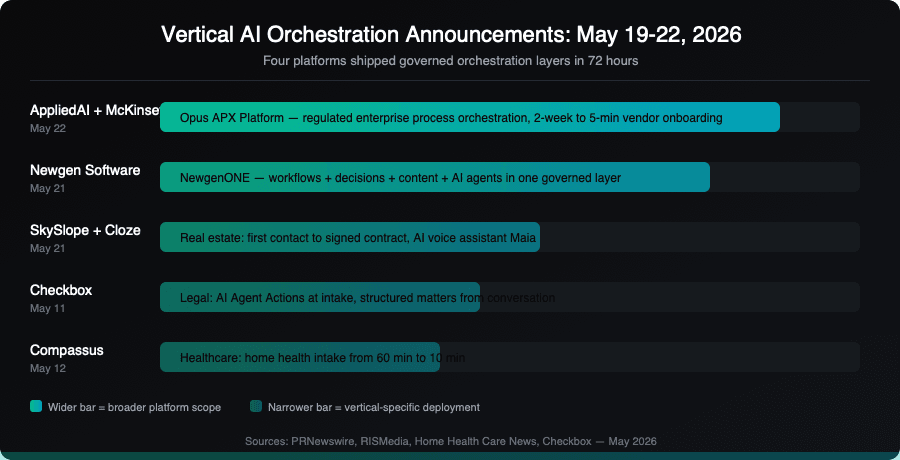
That gap is exactly what four independent platform vendors moved to close between May 19 and May 22. AppliedAI partnered with McKinsey to deploy its Opus Agentic Process Execution platform in regulated enterprises. Newgen Software launched an enterprise orchestration layer called NewgenONE. SkySlope and Cloze deepened their integration to carry real estate agents from first contact to signed contract in one workflow. And Compassus, a Tennessee-based home health provider, went live with an AI intake platform that compresses referral processing from an hour to under ten minutes.
The orchestration layer arrives
AppliedAI and McKinsey announced their collaboration on May 22. The partnership pairs McKinsey's transformation consulting and QuantumBlack's technical depth with Opus, AppliedAI's Agentic Process Execution platform. Their first joint deployment is telling: a European chemicals manufacturer cut a two-week vendor onboarding process to under five minutes of active processing, with a 99%-plus reduction in manual effort.
Opus decomposes enterprise processes into directed acyclic graphs where each node binds a frontier AI agent to schema-enforced input and output contracts. Every step is auditable, reproducible, and bounded. A Maker-Checker-Arbitrator governance model enforces separation of duty at every agent boundary. The platform is model-agnostic and designed for regulated industries: banking, healthcare, insurance.
Newgen Software took a different approach with the same goal. On May 21, the company introduced NewgenONE as a unified orchestration layer that embeds workflows, decisions, content, communications, and AI agents into a single governed environment. Rather than adding AI as a disconnected copilot layer, NewgenONE runs intelligence directly inside enterprise execution. The company reports deployment across more than 200 financial institutions globally.
The common thread: neither platform is building a better chatbot. Both are building the governance and orchestration infrastructure that lets AI agents operate inside real business processes without creating compliance risk.
What vertical intake looks like in production
The orchestration platforms solve the governance problem. But the more immediate story for operators is what happens when governed AI meets vertical-specific intake workflows.
Healthcare: Compassus, which operates over 300 home health and hospice programs across the US, built a custom AI intake platform that monitors referral sources, compiles incoming referrals into a single queue, and runs AI agents to check eligibility factors like zip code and insurance. The system combs through 60 to 80 pages of referral documents and completes checks in under ten minutes that previously took an hour. "We wanted to make it a strategic advantage," Evan Kramer, SVP of innovation at Compassus, told Home Health Care News. "It's faster response times for patients. It's better job satisfaction for our teams."
Legal: Checkbox expanded its AI Legal Front Door on May 11 with AI Agent Actions that convert a single conversation into a fully structured legal matter. When someone submits a request through Slack, email, or a web form, the AI agent asks qualifying questions, then automatically creates a populated matter on the legal board and kicks off the right workflow. The assigned attorney receives a structured, ready-to-action request with no manual triage required.
Real estate: SkySlope and Cloze expanded their integration on May 21 to cover the full transaction lifecycle from first contact to signed contract. Agents can now create and fill SkySlope Forms directly from a client or property record in Cloze, with client details and listing information pre-filled. Cloze's AI assistant Maia can generate pre-populated forms from voice commands. Ryan Raveis, co-president of William Raveis, described the integration as "everything, from first conversation to auto-filled agreements, streamlined in a single ecosystem."
Why the gap persists
If the technology works and the platforms are shipping, why does the 62%-to-23% gap exist?
The Futurum Group surveyed 820 enterprise decision-makers and found that 55% cite agent reliability as their top adoption challenge. Thirty-seven percent struggle to measure ROI from agentic deployments. The problem is not that AI agents cannot handle the work. The problem is that most organizations lack the infrastructure to govern, audit, and continuously improve agent-driven processes at scale.
This is where the orchestration platforms enter the picture. AppliedAI's approach encodes every workflow step as a schema-enforced contract with a full audit trail. NewgenONE embeds compliance directly into the execution layer so that every AI-led action is traceable and every workflow deviation is logged. Both platforms assume that regulated enterprises will not deploy AI agents unless they can explain exactly what happened, when, and why.
The vertical intake deployments tell a similar story from the operator side. Compassus built its intake platform with a partner rather than buying an off-the-shelf tool because no existing product handled the complexity of home health referral routing. Checkbox built its AI Legal Front Door as a unified platform connecting intake, workflow, and matter management because separate tools created the triage bottleneck in the first place.
What this means for buyers
Three practical takeaways for teams evaluating AI intake and workflow automation:
-
Start with the workflow, not the model. Every successful deployment in this cycle started from a well-understood business process: vendor onboarding, patient referral routing, legal matter intake, real estate transaction paperwork. The AI agents succeed because the process boundaries are clear.
-
Governance is a feature, not a checkbox. The platforms that moved this week compete on audit trails, human-in-the-loop checkpoints, and regulatory compliance. If a vendor cannot show you a full decision trace for every agent action, it is not built for regulated operations.
-
Vertical-specific beats general-purpose. Generic AI receptionists and chatbots handle surface-level intake. But the deployments producing measurable time savings are built for a specific domain: legal conflict checking, healthcare insurance verification, real estate MLS pre-fill. The domain knowledge embedded in these workflows is what separates a demo from production.
The pilot-to-production gap is real and well-documented. But this week's convergence suggests the infrastructure to close it is arriving quickly, and the vertical-specific deployments are already showing what production-grade AI intake looks like on the ground.
Sources:
- AppliedAI and McKinsey collaboration announcement (PRNewswire, May 22, 2026)
- Newgen Software NewgenONE announcement (PRNewswire India, May 21, 2026)
- SkySlope and Cloze expanded integration (RISMedia, May 21, 2026)
- Compassus AI intake platform (Home Health Care News, May 12, 2026)
- Checkbox AI Legal Front Door expansion (PRNewswire, May 11, 2026)
- Futurum Group enterprise AI survey (n=820), cited in Epicor Agentic AI Stack announcement, May 2026