Agentic AI Is Rewriting Legal and Healthcare Intake This Week
Four legal AI agent launches and Artera's $100M healthcare intake milestone signal that agentic AI intake has moved from pilot to production across verticals.
By SpringVanta
The first two weeks of May 2026 have delivered a clear signal: agentic AI has arrived in legal and healthcare intake, and it is no longer an experiment. In the span of eight days, four major legal platforms launched agent-driven systems, while a healthcare AI company crossed the $100 million annual recurring revenue mark doing essentially the same thing — replacing manual intake workflows with autonomous AI agents. Here is what happened, what it means for businesses evaluating AI intake, and why the vertical-by-vertical rollout pattern matters more than any single product launch.
Four Legal AI Platforms Launch Agent Systems in One Week
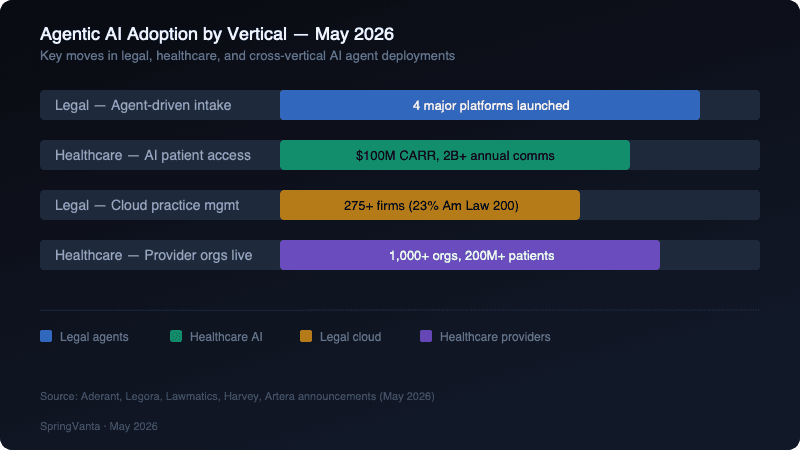
Between May 7 and May 15, 2026, the legal industry saw an unprecedented wave of agentic AI product launches: Legora aOS (May 7): Stockholm-based Legora unveiled an agentic operating system purpose-built for legal work. The Legora Agent handles end-to-end workflows from matter intake through research, drafting, and client delivery , not just individual tasks. A contract redline arrives at midnight; by morning, the agent has reviewed every change, flagged issues, and drafted a response. The system integrates directly with document management systems, legal research databases, and email. Aderant Agent Center (May 12): At its Momentum Global 2026 conference, Aderant announced an Agent Center built on the Stridyn platform and powered by its MADDI AI engine. The system orchestrates AI agents across the full work-to-cash lifecycle , from intake through billing, for law firm financial management, compliance, and talent operations. Aderant reports 275 firms have adopted its Expert Sierra cloud platform, including 23% of the Am Law 200. Lawmatics AI Suite (May 2026): Lawmatics rolled out an agentic and generative AI suite specifically targeting how law firms acquire clients, manage intake, and handle day-to-day operations , bringing AI-driven intake directly into the CRM layer that firms already use for lead management. Harvey Agent Library: Harvey expanded its platform with a library of over 500 pre-built legal agents covering practice areas from M&A and funds to white-collar investigations, plus an improved Agent Builder that lets teams customize agents to reflect their firm's specific expertise and precedents. Supio Agent: Built exclusively for plaintiff law firms, Supio's agentic AI platform operates across every matter from first call through final resolution, grounded in institutional knowledge and integrated with Thomson Reuters Westlaw Advantage.
Healthcare Patient Intake Goes Agentic at Scale
While legal was having its agent moment, the healthcare side was proving that AI-driven intake works at production scale.
Artera, recognized as the 2026 Best in KLAS winner for Patient Communications, has reached $100 million in contracted annual recurring revenue. The company supports over 1,000 healthcare organizations and handles 2 billion patient communications annually. Its AI agents now handle autonomous scheduling, intake, and patient access workflows across text, phone, and web channels.
At HIMSS 2026, Artera demonstrated live AI agents handling patient intake end-to-end, including a new focus on Voice AI for specialty practices. The company also introduced educational programming around Model Context Protocol (MCP) for healthcare interoperability , a sign that the infrastructure layer for agentic healthcare is maturing alongside the applications.
Meanwhile, MiiHealth AI announced its DAINA (Dynamic AI Intake and Navigation Assistant) collaboration with a leading health system, a fully autonomous, multilingual AI agent designed to modernize patient intake.
Druid AI's 2026 healthcare benchmark report adds context: patient identity and verification accounts for 26% of healthcare AI workflow volume, followed by patient access and appointment management at 19%. Patient intake and data capture, at 6%, is still early in its adoption curve , but that is exactly where the fastest growth is happening now.
What This Means for Businesses Considering AI Intake
These launches share a common pattern that matters for any business , law firm, clinic, or otherwise, evaluating AI intake automation: 1. Agents now handle the full lifecycle, not just forms. The Legora Agent reviews contracts overnight. Artera's agents schedule, intake, and follow up without human intervention. This is a fundamental shift from chatbots that answer FAQs to systems that execute complete workflows. 2. Vertical specialization beats horizontal tools. Every one of these platforms is purpose-built for a specific vertical. Legal agents understand jurisdiction, precedent, and clause banks. Healthcare agents navigate HIPAA, EHR integrations, and insurance verification. Generic AI tools cannot replicate this domain depth. 3. The data foundation is the real differentiator. Aderant's agents draw on decades of law firm financial data. Artera s 10 years and 2 billion patient interactions. The agents that work best are the ones trained on the most relevant domain data , which means your own operational data matters more than which model provider you choose. 4. Intake is the wedge, not the endgame. Every platform starts at intake , the first point of contact where data is captured and decisions are made. But the roadmap extends to full workflow orchestration: matter management in legal, care coordination in healthcare, deal pipeline in real estate. If you are evaluating AI intake tools, look at where the platform is headed, not just where it is today. 5. Security and compliance are table stakes. Artera is SOC 2 Type 2, HITRUST certified, and HIPAA compliant , and does not use PHI/PII in model training. Supio runs on a closed, HIPAA-compliant system. This is the standard that every vertical AI vendor will need to meet.
The Pattern: Vertical by Vertical, Intake First
The convergence is striking. In both legal and healthcare, AI agents are entering through the intake door , the high-volume, data-heavy, rules-driven front end of every professional workflow. The legal market saw four major platform launches in a single week. Healthcare is proving the model works at billion-communication scale. For businesses that rely on intake , law firms capturing new clients, clinics onboarding patients, real estate teams qualifying leads, the signal is clear: agentic AI intake is no longer emerging. It is deploying. The question is no longer whether AI agents will handle your intake workflows. It is which vertical-specific platform will do it best, and whether your data and processes are ready for them.
Sources: