AI Agents Stopped Being Add-Ons. They Moved Into Your CRM.
Close, Meta, and Salesforce all embedded AI agents inside CRMs and messaging apps on June 3, 2026. Here is what changed and what it means for lead qualification.
By Springvanta
Three companies launched AI sales agents on the same day. None of them are AI startups.
On June 3, Close shipped Chloe, a voice agent that calls your leads from inside your CRM. Meta rolled out Business Agent globally on WhatsApp, Instagram, and Messenger. Salesforce unveiled four new marketing agents at its Connections conference in Chicago, including Piper and Hunter, two AI sales development reps that identify, qualify, and route prospects without human involvement.
Separately, these are product launches. Together, they answer a question that's been floating since ChatGPT made AI accessible to everyone: where do AI agents actually live in a business? The answer from last week is that they live inside the tools you're already paying for.
Close: your CRM started dialing
Close, the SMB-focused CRM used by 11,500 businesses, launched Chloe, an AI voice sales teammate that operates directly inside the CRM. When a lead enters Close, Chloe calls them. She runs discovery conversations, qualifies prospects, books meetings, and updates CRM records. No separate dialer. No integration to configure. No new tab.
The beta numbers are worth a look: 238 businesses tested Chloe over several months. She made 780,915 calls, reached 104,251 prospects, and logged more than 6,424 hours of conversation. One customer, ClientMatchmaking.com, booked 30 meetings in their first week (a 50% increase) and described it as having "more coverage without hiring another person."
Close founder Steli Efti framed it plainly: "For most of the last twenty years, if you wanted faster lead response, more follow-up, or more sales activity, you hired more people. AI changes that equation."
Chloe also handles CRM enrichment, data updates, and a chat interface where users can query their sales data in natural language. Close says future capabilities will expand into account research and workflow execution. CRM software is moving from a system of record to a system of action, and Chloe is what that looks like in practice.
Chloe is available now for all U.S. Close customers.
Meta: AI agents where your customers already are
Meta's Business Agent takes a different route to the same destination. Instead of embedding AI into a CRM, it puts AI inside the messaging apps where customers already spend time: WhatsApp, Instagram DMs, and Messenger.
The scale is hard to ignore. More than one million businesses were already using early versions of Business Agent on WhatsApp and Messenger during a test phase that started in 2024. Meta says more than one billion active business threads now run daily across its messaging apps.
The agent answers business-specific questions, recommends products from a catalog, qualifies incoming leads, books appointments, and closes sales. It responds in the customer's language, matches the brand's tone, and hands conversations to a human when needed. Setup takes minutes. It starts free, with paid subscription tiers coming later.
Meta also launched the Business Agent Platform, which connects agents to tools like Shopify, Zendesk, and Shopee, giving the agent the ability to take action on behalf of the business rather than just chat. Zuckerberg's stated goal is for agents to "eventually help you run your whole business."
For businesses that sell through social channels or messaging-first markets (India, Brazil, Southeast Asia), this is already live and handling conversations.
Salesforce: four agents for the marketing stack
At Connections 2026 in Chicago, Salesforce announced four new Agentforce marketing agents that operate across its Data 360 and Marketing Cloud ecosystem.
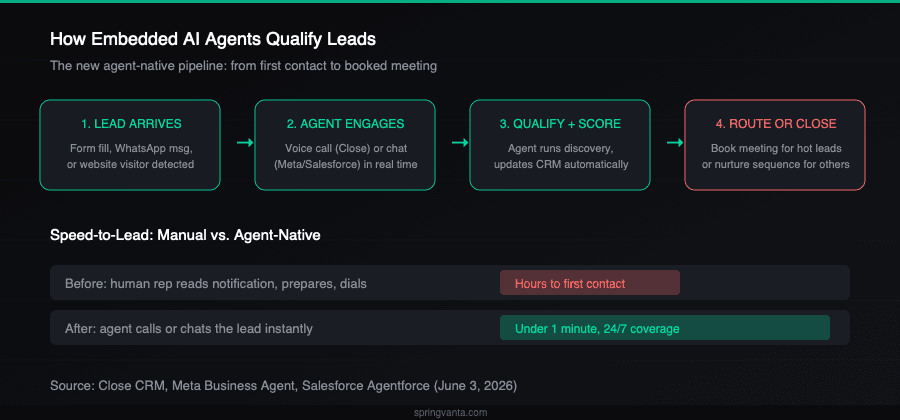
Two handle pipeline generation directly. Piper, built by Qualified (which Salesforce acquired in late 2025), identifies and qualifies inbound website visitors in real time, answers questions conversationally, and routes warm prospects to sales. Hunter focuses on outbound: it identifies potential contacts based on buying signals, initiates outreach, and runs email nurture sequences on its own.
The other two handle content and campaigns. The Agentforce Content Agent generates omnichannel marketing content from a single campaign brief. The Marketing Goals Agent lets marketers define budgets and objectives, then builds, launches, and optimizes campaigns against those goals.
Salesforce says Rawlings, the sports equipment company, cut campaign creation time by 75% using early versions of these tools. The company also released Agentic Segmentation, which lets marketers build audience segments from natural language prompts instead of SQL queries.
All four agents run on Salesforce's Data 360, meaning they draw from the same customer, sales, service, and commerce data that Salesforce already stores. No separate training. The agents already know the customer history.
What the convergence tells you
Three companies. Three platforms. Same week. The same bet: AI agents belong inside existing business tools, not as standalone products you have to shop for.
The practical takeaway depends on where you operate:
- If you run an SMB sales team, Close just made speed-to-lead automatic. Your CRM calls the lead before your team finishes reading the notification.
- If your customers reach you through messaging apps, Meta just gave you a free agent that qualifies, books, and sells inside those conversations.
- If you're in B2B marketing on Salesforce, you now have agents that handle prospecting, nurturing, content, and campaign optimization without leaving the platform.
None of these require you to evaluate, procure, and integrate a separate AI product. The agent ships inside the tool. You turn it on.
The first wave of AI business tools asked you to add something new to your stack. The second wave, which arrived on June 3, works inside what you already have.
Sources:
- Introducing Chloe, Your AI Sales Teammate in Close — Close Blog, June 3, 2026
- Be There for Every Customer With Meta Business Agent — Meta Newsroom, June 3, 2026
- Salesforce pushes agentic marketing from planning to pipeline — MarTech, June 3, 2026
- How Many AI Agents Is Too Many? Salesforce Adds Four More at Connections — Salesforce Ben, June 3, 2026
- Meta introduces AI Business Agent for WhatsApp worldwide — WABetaInfo, June 5, 2026