AI Intake Stops Answering Questions, Starts Closing Deals
In one week, Checkbox, Compassus, Crexi, and Supio all shipped action-first AI intake that doesn't just collect information — it routes, qualifies, and closes.
By Springvanta
Something shifted this past week across legal, healthcare, and real estate. In a span of four days : May 11 to 14 , every major vertical saw an AI intake launch that doesn't just answer questions or collect form data. These systems take action: routing referrals, structuring legal matters, qualifying real estate leads, and booking appointments without human intervention.
For SpringVanta buyers evaluating AI intake and automation, the signal is clear: the industry has moved from "AI that assists" to "AI that executes." Here's what happened, why it matters, and what to do about it.
The week that changed AI intake
Three separate product launches , each in a different vertical , share a common architecture: AI agents at the front door, not in the back office.
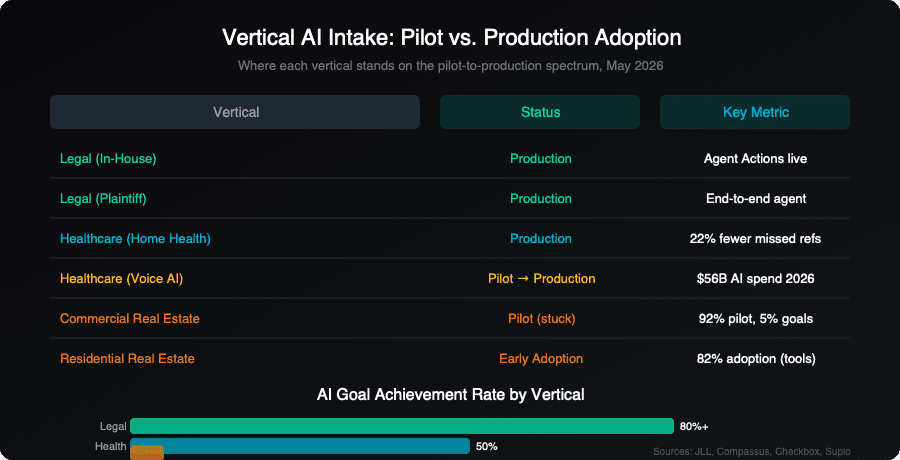
Checkbox (Legal, May 11): The in-house legal operations platform shipped AI Agent Actions, which turn a single conversation , a Slack message, an email, a compliance question , into a fully structured legal matter. The AI asks qualifying questions, then creates a populated matter on the legal board and kicks off the right workflow. The assigned attorney wakes up to a ready-to-action request. No manual triage, no back-and-forth.
Checkbox also launched AI Corrections, which let attorneys correct AI responses on the spot. Those corrections take effect immediately , no model retraining, no IT ticket. Over time, the AI becomes a living record of institutional knowledge.
Compassus (Healthcare, May 11): The home health and hospice provider, operating 300+ programs across the U.S., completed a pilot of its custom-built AI intake platform. The system monitors all referral sources , faxes, emails, portals , in one place, then AI agents check zip code, insurance, and service area eligibility across 60–80 pages of referral documents simultaneously.
The result: intake time dropped from an hour to under 10 minutes , an 83% reduction. Missed referrals fell by 22% in pilot markets. Timely initiation of care improved by 6%. And 80% of users reported being very satisfied with the tool.
Supio (Legal – Plaintiff, May 14): At its SupioSphere conference, the company launched Supio Agent, an end-to-end agentic AI platform for plaintiff law firms. The platform handles the full lifecycle , from the first client call through case resolution. It includes an integrated intake suite that ensures all client calls are answered and potential revenue isn't missed.
Crexi (Commercial Real Estate, May 13): Crexi expanded its AI capabilities across the deal workflow , research, market analysis, and transaction execution. Crexi Create generates structured offering memoranda from uploaded financials in minutes. The company positioned this as solving a structural gap: 92% of CRE organizations are piloting or planning AI initiatives, yet only 5% have achieved their AI program goals, according to JLL's Global Real Estate Technology Survey.
What all of these have in common
Beneath the different verticals, the same architectural pattern is emerging:
1. AI sits at the front door, not the back office.
Checkbox's AI Legal Front Door. Compassus's intake-first platform. Supio's first-call agent. In every case, the AI intercepts the request before a human touches it. This is the shift that matters most. When AI is embedded at the point of first contact, it can triage, qualify, and route before the cost of manual handling compounds.
2. Action, not just information.
These systems don't return answers or surface documents. They create matters, book appointments, populate workflows, and escalate to the right person. The AI doesn't suggest what to do next , it does it.
3. Revenue impact, not just time savings.
Compassus reduced missed referrals by 22%. That's not a productivity metric , it's a revenue metric. More referrals captured means more patients served and more revenue from hospital system partners. Similarly, Checkbox's AI Agent Actions eliminate the triage bottleneck that causes legal requests to stall, directly reducing cycle time.
4. Enterprise-grade, not experimental.
Compassus built its tool in-house because existing intake products weren't enterprise-ready. Checkbox and Supio are deployed at scale across hundreds of organizations. Crexi's AI runs on proprietary transaction data, not generic models. These are not pilots or proofs of concept , they're production systems with measurable outcomes.
Why this matters for SpringVanta buyers
If you're evaluating AI intake for your business , whether it's client intake for a law firm, patient intake for a healthcare practice, or lead intake for a real estate brokerage , the bar has moved.
Conversational intake is now table stakes. The form-based intake that loses 67% of legal leads or misses 30% of after-hours patient calls is no longer competitive. The new standard is AI that conducts a meaningful conversation, captures context that static fields miss, and takes action on the result.
Look for platforms that own the full workflow. Checkbox works because it owns intake, workflow, and matter management on one platform , the AI can close the loop from conversation to structured matter. Compassus works because it monitors all referral sources and integrates with the EMR. Piecemeal AI bolted onto existing forms won't deliver the same ROI.
Measure revenue impact, not just time saved. Ask vendors for pilot results: what happened to conversion rates, referral capture, lead-to-consultation ratios? If they can't answer, they're still in the old model.
The 92%-to-5% gap is your opportunity. In commercial real estate, nearly everyone is piloting AI, but almost no one has achieved their goals. The reason, as JLL's survey found, is structural: existing tools automate discrete tasks without connecting end-to-end workflows. The same gap exists in healthcare intake, legal intake, and real estate lead management. The platforms that close it , by embedding AI at the front door and letting it act , are where the competitive advantage lives.
The road ahead
Compassus's Evan Kramer laid out the roadmap clearly: intake, scheduling, engagement. The company plans through the end of 2027, focusing on automating administrative tasks to raise care and improve efficiency.
That progression , intake first, then scheduling, then engagement , is likely the template for every vertical. Legal will follow the same path: intake, matter management, client engagement. Real estate: lead intake, showing scheduling, transaction management.
The organizations that get intake right now will have the data infrastructure and AI muscle memory to automate the next stages faster. The ones still piloting disconnected tools will fall further behind.
The week of May 11–14, 2026, didn't just produce new product launches. It established the pattern for how vertical AI intake works when it's done right: AI at the front door, acting on requests, and closing deals , not just collecting them.
Sources: Checkbox AI Legal Front Door (PR Newswire, May 11, 2026); Compassus AI Intake (Home Health Care News, May 11, 2026); Supio Agent (PR Newswire, May 14, 2026); Crexi AI (PR Newswire, May 13, 2026); JLL Global Real Estate Technology Survey (via Crexi announcement); Perspective AI: AI Legal Intake (March 2026).