Your Best SEO Pages Are Invisible to AI Search. New Data Proves It.
A 150K-page study found 49% of top organic pages get zero AI traffic. ChatGPT referrals spiked 158%. AI search and SEO are now separate channels.
By Springvanta
Three separate data points dropped in the last week of May 2026, and together they tell a story most marketing teams have not internalized yet: the pages that win Google search are not the pages that win AI search.
A study published by Search Engine Land analyzed roughly 150,000 indexed pages across 10 websites and found that nearly half, 49 out of 100, of the top-performing organic search pages received zero traffic from AI-powered search. The top 10 organic pages captured 55% of all organic sessions but only 29% of AI search sessions. Different pages, different audiences, different rules.
Meanwhile, Similarweb data reported by SEO Francisco showed ChatGPT referral traffic spiking roughly 158% week-over-week after a May 7 change to how ChatGPT handles outbound links. Homepage referrals specifically jumped 355%. And Adobe Analytics, cited by the Korea JoongAng Daily, recorded a 393% year-over-year increase in AI-driven traffic to US retail sites in Q1 2026, with only 12% overlap between the pages AI sends traffic to and the pages ranking in Google's top 10.
The content types that win AI citations are not what you'd expect
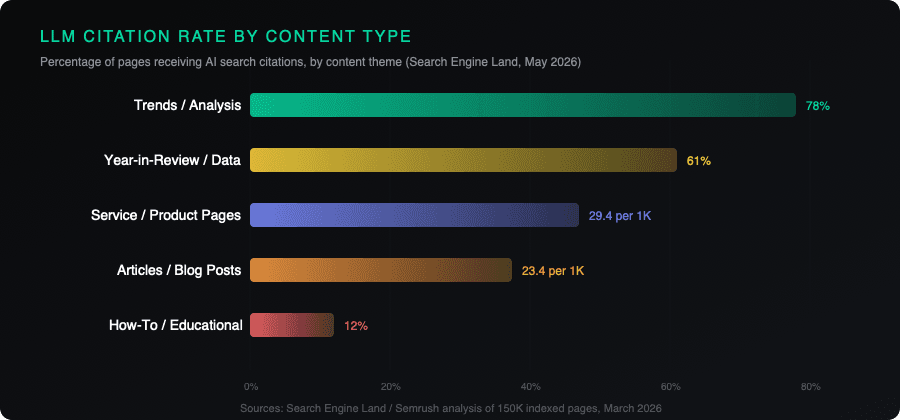
The Search Engine Land study broke down which content themes attracted LLM citations and which did not. The results are counterintuitive if you have spent the last decade optimizing for Google.
Trends and analysis content attracted LLM citations 78% of the time. Data-heavy year-in-review pieces: 61%. Service and product pages delivered 29.4 AI search sessions per 1,000 organic sessions, which is a higher rate than general articles at 23.4 per 1,000. Educational how-to content, the backbone of most SEO strategies, pulled LLM citations just 12% of the time.
This flips the standard SEO playbook. For years, the advice was "write helpful how-to content and the traffic will follow." That still works for Google. For AI models like ChatGPT, Perplexity, and Gemini, what gets cited is original analysis, proprietary data, and opinionated takes on industry trends.
The ChatGPT referral spike changes the math
The 158% referral jump matters because it signals that AI search is no longer a zero-click channel. Before May 7, ChatGPT users who asked about a product or brand typically got their answer in the chat window and moved on. After the link-handling change, roughly 60% of ChatGPT referral traffic landed on brand homepages rather than deep article pages. People are clicking through to learn more.
For businesses that have been treating AI search as a branding exercise with no measurable return, this is the moment to reconsider. ChatGPT is now sending real visitors to real pages. The question is whether your site gives those visitors something worth reading when they arrive.
What this means if you sell or buy AI automation tools
If your business is in AI intake, voice agents, CRM automation, or any of the adjacent markets SpringVanta covers, there are three practical implications:
Write analysis and trend pieces, not just tutorials. AI models cite original analysis at 6.5 times the rate of how-to content. If your blog is nothing but "how to set up X" posts, you are invisible to AI search regardless of your Google rankings.
Audit your service and product pages for AI readability. Service pages outperformed general articles in LLM sessions per 1,000 organic visits. Make sure your product pages include clear descriptions, use cases, and comparison points that an AI model can parse and cite.
Track AI referral traffic separately from organic. The 49% gap between top organic pages and AI traffic means your existing analytics are probably hiding a growing channel. Set up UTM tracking or referrer filters for ChatGPT, Perplexity, and Gemini so you can see which pages they send traffic to.
The divergence is accelerating
The SEO and GEO gap study was based on March 2026 data. The ChatGPT referral spike happened in early May. The Adobe retail traffic numbers cover Q1 2026. All three are measuring a moving target. AI search behavior is changing month to month as models update, as link handling evolves, and as users shift from asking questions in Google to asking them in ChatGPT.
The organizations that treat AI search as a separate channel with its own content strategy, rather than a quirky add-on to their SEO plan, are the ones that will show up in AI answers six months from now. Everyone else will keep ranking on page one of Google while their competitors collect the AI referral traffic they never saw coming.
Sources:
- Search Engine Land, "Is there a gap between SEO and GEO? New study says yes" (May 28, 2026)
- SEO Francisco, "ChatGPT referral traffic data reveals the future of AI search" (May 2026)
- Korea JoongAng Daily / Adobe Analytics, AI-driven retail traffic report (Q1 2026)