AI Sales Agents Moved Into the CRM This Week
Close embedded an AI agent in its CRM. ZoomInfo became the data layer for every major agent platform. Pega added governance. Same week, same shift.
By SpringVanta
Three things happened between June 8 and 10. Close launched Chloe, an AI sales agent that lives inside its CRM. During beta, 306 businesses used it to make 818,787 calls. ZoomInfo's GTM.AI became the data backbone for HubSpot Breeze, IBM watsonx Orchestrate, and OpenAI Codex for Work. Pega debuted Customer Engagement Studio at PegaWorld, putting agentic AI into the marketing operations workflow.
Different companies, different markets. Same move: the AI agent stopped being a product you add and started being something already inside the tool you use.
Close: the agent is the CRM
Most AI SDR tools are standalone. You connect them to your CRM, sync data back and forth, and hope nothing breaks mid-pipeline. Chloe runs inside Close. It already has access to customer history, deal context, previous conversations, and workflow automation before every call. No sync. No separate dashboard.
The beta numbers are worth pausing on. 818,787 calls across 306 businesses. 111,915 prospects reached. 6,424 hours of conversation, roughly 268 days of nonstop calling. One customer, ClientMatchmaking.com, booked 30 meetings their first week. That is a 50% increase.
Steli Efti, Close's CEO, framed it plainly: "The biggest opportunity with AI is not replacing salespeople. It is giving small businesses leverage they could not afford before."
Close serves about 11,500 businesses, most of them small teams. Chloe is available on all plans, starting at $19/month for the Solo tier, with AI credits included. During open beta, voice calls are free. A two-person sales team can have an AI agent qualifying leads overnight without adding a seat or signing a new contract.
ZoomInfo: the shared data layer
If Close is about where the agent lives, ZoomInfo is about what the agent knows.
Between June 1 and June 9, ZoomInfo made GTM.AI, its headless context layer, available across Salesforce Agentforce, HubSpot Breeze, Microsoft Copilot, IBM watsonx Orchestrate, OpenAI Codex for Work, Claude, ChatGPT, and dozens of other platforms. Same verified data graph underneath all of them: 100 million companies, 500 million contacts, billions of buying signals, accessible through API and the Model Context Protocol.
The HubSpot Breeze integration is the most concrete for smaller teams. Breeze handles the full prospecting cycle: identify accounts, source contacts, execute outreach. ZoomInfo feeds it verified contact data, intent signals, and buying committee information. The agent pulls from a continuously refreshed graph rather than guessing who to call.
The IBM watsonx connector goes further. It exposes ZoomInfo data as first-class tool calls inside IBM's agent builder. Any agent, pre-built or custom, can query the GTM Context Graph for lookups, enrichment, intent signals, and technographics. No middleware between the agent and the data.
The problem these integrations address is not theoretical. About 70% of B2B contact data decays every year. An AI sales agent running on stale data makes bad calls at machine speed: wrong contacts, dead emails, pitches aimed at the wrong buyer. Verified data through a shared context layer is how the major platforms are trying to prevent that.
Pega: governance for the enterprise
At PegaWorld on June 8, Pega launched Customer Engagement Studio, an agentic workspace built on top of its Customer Decision Hub. The pitch: marketers work alongside AI agents to move from brief to a live, personalized campaign in minutes, with governance and compliance built in.
Pega's angle is enterprise-grade. The workspace unifies Pega agents and third-party agents in a single governed environment. Human oversight validates every output before a next-best-action reaches a customer. Rob Walker, Pega's GM for 1:1 customer engagement, described the goal as scaling relevance without adding uncertainty.
Gartner projects 60% of brands will use agentic AI for 1:1 interactions by 2028. But the same research says more than 40% of agentic AI projects will get canceled due to rising costs, unclear outcomes, or inadequate risk controls. The governance layer is not decorative. It is what separates a pilot that scales from one that dies in a budget review.
Futurum Research called Pega's approach a platform-centric bet that forces a rethink for both buyers and competitors. Whether it works at scale is an open question. But the framing is honest: agentic marketing without governance is a demo, not a deployment.
What this means for you
Three different approaches aimed at three different segments:
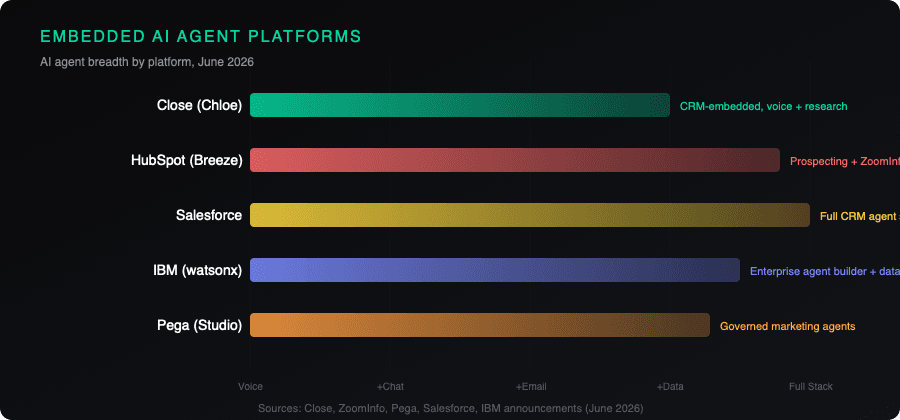
- Close: Agent embedded in the CRM, aimed at small teams. $19/month starting point. Voice-first. No integration.
- ZoomInfo GTM.AI: Shared data context layer across every major agent platform. Verified data, MCP access, one governance posture.
- Pega: Governed agentic workspace for enterprise marketing. Human oversight. Audit-ready.
The agent is no longer something you evaluate, buy, and wire up. It shows up inside the platform you already pay for, with the data and context already connected.
For businesses evaluating AI for lead qualification and intake, the practical question has shifted. It is not "which AI agent should I buy?" It is "does my CRM have one built in, and is the data it runs on verified?"
Close has Chloe. HubSpot has Breeze with ZoomInfo underneath. Salesforce has Agentforce. Pega has Customer Engagement Studio. The list will get longer.
Sources
- Close launches Chloe (June 3, updated June 9)
- Close Chloe GA announcement, Markets Insider (June 9)
- ZoomInfo selected for HubSpot Breeze Prospecting Agent (June 9)
- IBM watsonx Orchestrate powered by ZoomInfo GTM.AI (June 9)
- Pega Customer Engagement Studio announcement (June 8)
- Futurum Research analysis (June 2026)
- ZoomInfo GTM.AI GA, VentureBeat (June 2)