Voice AI Stops Being a Demo, Starts Being Infrastructure
Four platforms shipped production voice AI tooling in one week: Kore.ai Artemis for governance, PolyAI for self-serve dialog, Quiq for unified voice and AssemblyAI.
By Springvanta
Something shifted this week in voice AI. Not a single breakthrough, but four independent companies shipping production tooling within days of each other. Kore.ai launched a governed multiagent platform on Azure. PolyAI opened its enterprise dialog system to anyone with an email address. Quiq extended its customer service platform into real-time voice. AssemblyAI pushed a speech model that actually handles messy, multilingual audio.
None of these are demos. They are infrastructure for companies that need voice AI to work at scale, with compliance, audit trails, and costs that make sense. The difference matters.
What actually shipped
Kore.ai Artemis (May 21) is the biggest of the bunch by scope. The company launched a new "Agent Platform" with two pieces that caught my attention. First, Agent Blueprint Language (ABL), a compiled, declarative language for defining how agents behave, what they can access, and how they hand off to each other. Second, a "Dual-Brain" architecture that runs agentic reasoning and deterministic flows in parallel through shared memory. The idea is that governance lives in the compiled blueprint, not in the model's behavior, which means a CISO can audit what an agent will do without trusting the LLM to self-regulate.
Kore.ai positions this for the Global 2000. FedRAMP Moderate, SOC 2 Type II, HIPAA-aligned, 300+ integrations, 40+ voice and digital channels. It launches exclusively on Azure, integrated with Microsoft Foundry, Agent 365, and Entra ID. Early customers include Vanguard and Blue Cross Blue Shield of Massachusetts. That is not a startup buyer list.
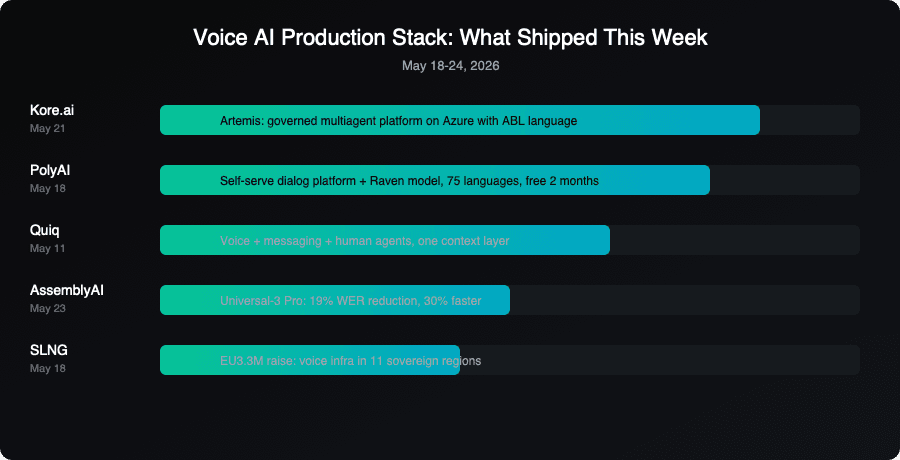
PolyAI (May 18) went the opposite direction. Instead of tightening access with enterprise controls, it opened its Agentic Dialog Platform to anyone. Free for two months, production-ready agents in under ten minutes. The company claims its Raven dialog model was trained on over a billion real enterprise conversations, not scraped web text. That training shows up in places that matter: gas leak calls at utility companies, medical appointment screenings, payment disputes at banks. These are conversations where context has to hold under pressure, not just chit-chat that drifts into something plausible.
PolyAI already runs these workloads for Marriott, FedEx, PG&E, and Foot Locker. Its largest deployments do work equivalent to more than 1,000 full-time employees per enterprise. Opening the platform is a bet that smaller companies want the same quality without the enterprise sales cycle.
Quiq (May 11) added voice to its existing AI customer service platform. The interesting part is not the voice capability itself, but the architecture around it. Voice, messaging, and human agents all share a single context layer. When a customer calls and gets routed to a human, the agent sees everything the AI already tried. One Quiq customer runs a single AI agent across four brands, seven countries, and four communication channels simultaneously, adjusting language and brand voice per interaction. That is the operational complexity voice AI has to handle before it graduates from pilot.
AssemblyAI (May 23) shipped Universal-3 Pro, a speech-to-text model with a 19% improvement in multilingual word error rate and 30% faster processing. Speech-to-text is the cheapest component in a voice AI stack (around $0.003-0.018 per minute depending on provider), but accuracy on real-world audio, accented speech, background noise, people talking over each other, is what separates a functional agent from one that frustrates callers. AssemblyAI's move is incremental but directly relevant to production quality.
Why this week matters
Read these launches side by side and a pattern shows up. Every single one is solving for production, not novelty.
Kore.ai built a compiled language to make agent behavior auditable. PolyAI opened a platform proven on a billion conversations. Quiq unified voice and text under one context layer so context does not vanish at handoff. AssemblyAI tightened the accuracy on the input layer where errors cascade downstream.
This is what "the boring part" of voice AI looks like. Governance, audit trails, context persistence, billing that scales. It is the stack that enterprises need before they will let an AI agent touch a real customer call. And four companies just shipped pieces of it in the same week.
For businesses evaluating voice AI, the practical takeaway is straightforward. The technology is past the proof-of-concept stage. The question is no longer "can voice AI handle a real conversation?" but "which stack gives me the control and visibility I need to deploy it at scale?" That is a much better question to be answering.
What to watch next
Kore.ai's ABL is the most interesting bet here. If compiled agent blueprints become a standard, it changes how enterprises think about AI governance, from "we monitor the model" to "we compile and review the agent's decision logic before it ships." That is the difference between observing behavior after the fact and approving behavior before deployment.
PolyAI's self-serve model will also be worth tracking. Enterprise dialog platforms have historically required six-figure engagements. If the usage economics work at lower volumes, it opens the market for mid-market companies that have been priced out.
Sources:
- Kore.ai Artemis Launch (Kore.ai, May 21, 2026)
- PolyAI Opens Agentic Dialog Platform (PR Newswire, May 18, 2026)
- Quiq Extends AI Agent Platform Into Voice (SiliconANGLE, May 11, 2026)
- PolyAI Platform Coverage (CMSWire, May 2026)
- Kore.ai Artemis Analysis (Windows Forum, May 2026)