Healthcare Voice AI Graduates From Pilot to Production
Hippocratic AI, Carlyle's $600M RCM deal, and real hospital data show healthcare voice AI has moved past pilots into production-scale patient intake.
By SpringVanta
Healthcare organizations spent years running AI voice agent pilots , carefully controlled demos that resolved a handful of tasks in a sandbox. That era is ending. In the past month alone, a wave of production deployments, a massive private-equity consolidation, and a new generation of clinically validated voice models have shifted the conversation from "what if" to "what's live."
Three developments tell the story: Carlyle's $600 million combination of Knack RCM and EqualizeRCM to build an AI-native revenue cycle platform, Hippocratic AI's launch of its AI Front Door and Polaris 5.0 model validated across 180 million patient interactions, and Overlake Medical Center's published results showing 90 percent digital inquiry resolution with Hyro's voice agents.
Together they signal something bigger than any single product launch. Healthcare voice AI has graduated.
Carlyle Bets $600M on AI-Native Revenue Cycle Management
On May 4, 2026, Carlyle announced the acquisition of majority stakes in Knack RCM and EqualizeRCM , two US healthcare revenue cycle management providers , to create what it calls an AI-native, global, multi-specialty RCM platform. Including debt, the deal is valued at approximately $600 million.
The combined entity serves physician groups, durable medical equipment providers, rural hospitals, and specialty clinics. Knack brings 8,000 employees and its Workmate orchestration engine across the US, India, and the Philippines. EqualizeRCM contributes its Bill Smart denial-prediction tool and an AI-native platform built on large language models and agentic AI that has already displaced established vendor contracts at leading DME manufacturers.
This is not a technology experiment. Carlyle hired Gautam Barai, former COO at WNS, to run the platform with plans for a public listing this fiscal year. The bet is that agentic AI , not just rule-based bots , can handle the most complex revenue cycle workflows end-to-end: intake, claims processing, denial prediction, and appeals.
For healthcare operators evaluating AI automation, this is a clear signal. The revenue cycle is no longer a back-office cost center that might benefit from AI. It is becoming an AI-native function where the competitive advantage goes to organizations that automate first.
Hippocratic AI Launches AI Front Door and Polaris 5.0
Hippocratic AI made two significant moves in April 2026 that reshape how healthcare organizations can think about patient intake.
First, it launched AI Front Door , an omni-topic voice AI agent that replaces fragmented call centers and digital front doors with a single, continuous patient relationship. Instead of phone trees, transfers, and disconnected interactions, one AI agent handles scheduling, lab results, billing, care follow-ups, triage, and referral coordination across voice, SMS, chat, and app channels. It remembers patient history and preferences across interactions, building a longitudinal relationship rather than handling each call as a standalone transaction.
Then, on April 30, Hippocratic AI released Polaris 5.0 , a 5-trillion-parameter constellation model with a 700-billion-parameter core, benchmarked against GPT 5.4 Pro, Claude Opus 4.7, and Gemini 3.1 Pro. Across 50+ benchmarks, Polaris 5.0 outperforms these frontier models on clinical accuracy, HIPAA compliance, empathy, and multi-step conversation consistency.
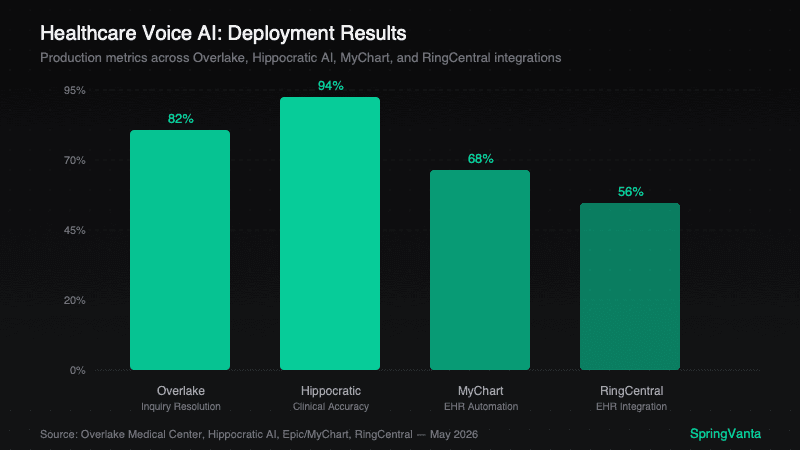
The production numbers are striking: 180 million patient interactions, 99.90 percent correct clinical advice, zero severe harm events, and validation from 7,500+ US-licensed clinicians. New capabilities include contextual speech recognition tuned for drug names and clinical terms (87 percent first-pass accuracy), drug safety verification (99.95 percent), clinical escalation across eight symptom categories (99.75 percent), cough detection for at-home respiratory assessment, and Mandarin language support with mid-call switching.
For organizations building patient intake workflows, AI Front Door represents a different architecture. Rather than bolting a chatbot onto an IVR system, it provides a single agent that resolves complete patient needs , from scheduling to benefits verification to post-visit follow-up , in one conversation.
Real Hospital Results: Overlake Medical Center and the Hyro Model
The Overlake Medical Center partnership with Hyro offers concrete production data that grounds the broader market narrative. Deployed across the health system's patient access operations, Hyro's AI agents achieved:
- 51 percent automation of MyChart password resets, eliminating a high-volume, low-complexity task that consumed significant staff time.
- 90 percent resolution of all digital patient inquiries, meaning only one in ten contacts requires human escalation.
- Coverage across scheduling, prescription refills, referral coordination, and general information requests.
These are not pilot metrics. They represent sustained production performance at a multi-site health system. The impact compounds: every automated inquiry is a phone call that front-desk staff do not need to answer, a wait time patients do not experience, and a capacity slot opened for complex cases that genuinely require human judgment.
RingCentral Enters Healthcare with Agentic Voice AI
RingCentral launched AIR Pro for Healthcare, extending its agentic voice AI platform into clinical settings. The product integrates with 80+ EHR systems and handles scheduling, intake, prior authorization follow-up, and post-visit engagement.
The entry of a major unified-communications vendor into healthcare voice AI is significant. It signals that the market has moved beyond early-stage startups solving point problems. Established platforms are now building healthcare-specific voice agent capabilities, which brings enterprise-grade reliability, security certifications, and integration depth that health system IT teams require.
What This Means for Organizations Evaluating AI Intake
The common thread across these developments is production readiness. The question is no longer whether AI voice agents can handle healthcare intake , it is how quickly organizations can deploy them and what outcomes they deliver.
For health systems and hospitals: The AI Front Door model from Hippocratic AI, combined with Hyro-style patient access automation and RingCentral's EHR integrations, provides a blueprint for replacing fragmented call center operations with unified voice AI. Start with the highest-volume, lowest-complexity tasks (password resets, scheduling, prescription refills) and expand to clinical triage and care coordination as confidence builds.
For revenue cycle teams: Carlyle's $600M investment in AI-native RCM signals that denial prediction, claims processing, and prior authorization are moving from manual workflows to agentic automation. Organizations that delay adoption risk competing against AI-native platforms that resolve claims faster and at lower cost.
For AI automation vendors: Healthcare is becoming the proving ground for regulated-industry voice AI. The same architectural patterns , governed agents, audit trails, compliance-by-design , that work in healthcare intake will apply to legal intake, insurance claims, and financial services onboarding.
The pipeline from pilot to production is shortening rapidly. Organizations that moved early are already reporting measurable outcomes. Those still evaluating should accelerate their timelines.
Sources:
- Carlyle Acquires Knack RCM and EqualizeRCM (Carlyle, May 4, 2026)
- Hippocratic AI Launches AI Front Door and Nurse Co-Pilot (BusinessWire, April 16, 2026)
- Hippocratic AI Launches Polaris 5.0 (Hippocratic AI, April 30, 2026)
- Carlyle Acquires Knack RCM and EqualizeRCM : Analysis (HIT Consultant, May 6, 2026)
- Carlyle Buys Knack and Equalize for $600 Million (Economic Times, May 5, 2026)