Google's AI Search Guide: SEO Still Works, But Only for Google
Google's first official AI search optimization guide says GEO is just SEO and dismisses llms.txt. But ChatGPT and Perplexity play by different rules.
By Springvanta
On May 15, 2026, John Mueller published something Google had never produced before: a consolidated guide telling website owners exactly how to optimize for generative AI features in Google Search. The guide is clear, pragmatic, and in some ways more notable for what it dismisses than for what it recommends.
The message boils down to one sentence: your existing SEO is your AI search strategy. Google's AI Overviews and AI Mode are rooted in the same ranking and quality systems that power traditional results. There is no separate track.
For businesses investing in AI discoverability, that sentence is both reassuring and incomplete. Here is what the guide actually says, where it leaves gaps, and what to do about the platforms Google does not control.
What the guide covers
Google organized the new resource into five sections:
-
Why SEO remains relevant for AI search. The guide states plainly: "The best practices for SEO continue to be relevant because our generative AI features on Google Search are rooted in our core Search ranking and quality systems." AI Overviews and AI Mode use retrieval-augmented generation and query fan-out to pull from Google's existing index. If a page does not rank, it does not get cited.
-
Practical format guidance. Tips for local, shopping, image, and video content, acknowledging that generative AI features do not treat all formats identically.
-
Mythbusting. This is the section generating the most discussion. Google explicitly lists tactics it says you can ignore for its AI features.
-
Agentic experiences. Preliminary guidance on AI agents that can complete tasks on behalf of users. Google frames this as optional and forward-looking, referencing standards like Universal Commerce Protocol and WebMCP.
-
Next steps. A reinforcement section pointing back to the SEO Starter Guide.
The mythbusting section: four things Google says to stop doing
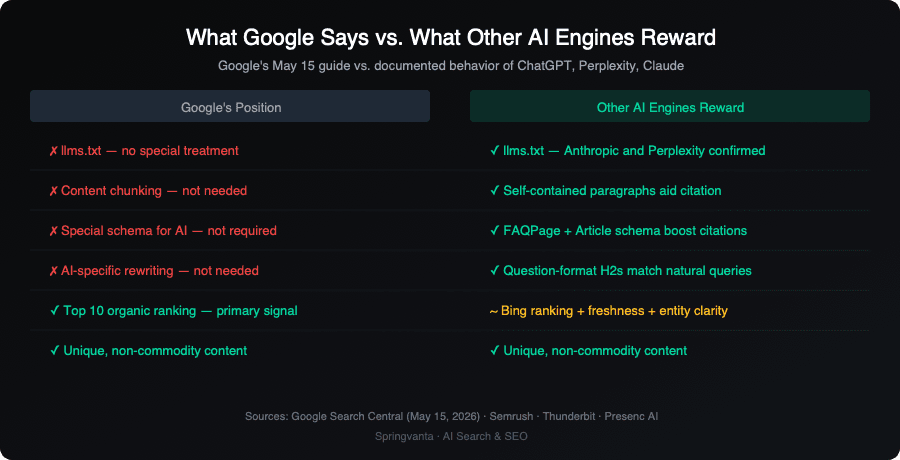
This is where the guide gets blunt. Google says SEOs can ignore the following for its generative AI features:
- llms.txt files. Google's crawler may discover these files but treats them like any other text file. No special indexing pathway exists.
- Content chunking. No need to break articles into small pieces. Google's systems can extract relevant passages from multi-topic pages.
- AI-specific rewriting. AI features understand synonyms and general meaning. Rewriting to capture every long-tail variation is unnecessary.
- Special schema or Markdown versions. Not required for inclusion in Google's generative AI results.
Google also cautions against seeking inauthentic brand mentions, noting that its generative features rely on the same spam-blocking systems as core ranking.
The 96% problem
A Brainlabs study from July 2025 found that 96% of links in AI Overviews came from pages already in the top 10 organic results. That number has become one of the most cited data points in the AI search conversation, and Google's guide effectively confirms it: the path into AI Overviews runs through conventional ranking.
Meanwhile, SISTRIX data from March 2026 shows click-through rates at position one collapsing from 27% to 11%, driven by AI features answering queries directly on the results page. Fewer clicks reach your site even when you rank first.
Here is the tension: Google says keep doing good SEO. Good SEO now produces less traffic than it did 18 months ago. The clicks that do arrive are worth more (Semrush found AI search visitors are 4.4x more valuable economically than traditional organic visitors), but the volume decline is real.
What Google's guide does not cover
The guide applies only to Google's ecosystem. That qualifier matters because AI search is no longer a single-engine game.
Averi's analysis of 680 million AI citations in early 2026 found that only 11% of domains were cited by both ChatGPT and Perplexity. Ahrefs reported a similar 12% overlap between AI platforms and Google's top 10. These are different systems with different citation patterns, different indexes, and different preferences.
While Google dismisses llms.txt, the market keeps building it. A Thunderbit crawl of the Tranco Top 10,000 domains in May 2026 found 586 valid llms.txt files (5.86% adoption), with adopters including Cloudflare, Stripe, Salesforce, GitHub, and Adobe. Anthropic and Perplexity have both confirmed they use llms.txt as a signal for page prioritization.
The developer community has noticed the contradiction. One Next.js developer published a widely read post on May 21 titled "I Built a Dynamic llms.txt. Then Google Said Don't Bother." The conclusion: keep the file anyway, because it costs nothing and multiple non-Google AI engines do read it.
What businesses should actually do
The practical takeaway is not to pick a side. It is to run a two-track strategy:
Track 1: Google (follow the guide). Invest in unique, non-commodity content. Maintain technical SEO fundamentals: crawlability, structured data, fast page experience. These remain the strongest signals for AI Overviews and AI Mode. Do not waste time on llms.txt for Google specifically.
Track 2: Everyone else (fill the gaps Google ignores). Publish an llms.txt file at your domain root. Anthropic and Perplexity confirmed they read it, and more platforms may follow. Structure content with clear question-format headings that match natural language queries. Build entity clarity through consistent brand mentions across third-party sources, because 85% of AI visibility comes from off-site signals, not your own website.
The businesses that treat AI search as a single optimization problem will optimize well for Google and leave the other third of AI citations unclaimed.
Sources
- Google Search Central Blog: A new resource for optimizing for generative AI in Google Search (May 15, 2026)
- Semrush: Google publishes guide to optimizing for generative AI search (May 19, 2026)
- PPC Land: Google's new guide for AI search: what SEO really needs now (May 15, 2026)
- Thunderbit: The Rise of llms.txt: How Websites Are Signaling to AI (May 8, 2026)
- Presenc AI: State of llms.txt 2026 (April 2026)