The Data Trust Layer Just Became a Product Category
Veeam, Palo Alto Networks, and Informatica all shipped data-trust infrastructure for AI agents in the same two-week window. The missing layer in the AI stack now has t...
By SpringVanta
Between May 12 and May 20, 2026, three enterprise infrastructure companies independently shipped products built on the same premise: the biggest risk in AI agents isn't the model , it's the data they touch.
Veeam launched a "DataAI Command Platform" at VeeamON in New York. Palo Alto Networks published a detailed architectural guide for data-centric agent security. And at Informatica World in Las Vegas, Salesforce-backed Informatica unveiled headless data management with MCP-native governance.
None of them coordinated. All of them converged on the same thesis: govern the data, not just the agent.
Why this matters for businesses buying AI
If your company is deploying AI agents for intake, customer service, lead qualification, or any workflow that touches real business data, this convergence is relevant for a simple reason. The infrastructure to deploy AI agents already exists. The infrastructure to trust what those agents do with your data does not.
Veeam's CEO Anand Eswaran put it plainly: "The infrastructure to deploy AI exists. The infrastructure to trust it doesn't."
His company's research found that autonomous AI agents now outnumber human employees at a ratio of 82 to 1 inside enterprise environments, and 97% of those agents carry excessive privileges. That's not a theoretical risk. That's an operational gap that explains why so many AI pilots look great in demo but fail in production.
The 85/15 gap
The timing lines up with data from Fivetran's 2026 Agentic AI Readiness Index (released May 5). That survey of 400 data professionals found that only 15% of organizations are fully prepared to support agentic AI in production , even as nearly 60% are investing millions to deploy it.
The blockers aren't model quality or talent. They're data quality, lineage, governance, and interoperability. Forty-two percent of respondents cited data quality and lineage as the primary barrier. Regulatory compliance and sovereignty (39%) and security and privacy risk (39%) followed close behind.
Gartner has projected that up to 60% of AI projects may be abandoned due to a lack of AI-ready data. The vendor response in May suggests the industry has stopped waiting for organizations to fix their data foundations on their own , and started building products to do it for them.
What each vendor shipped
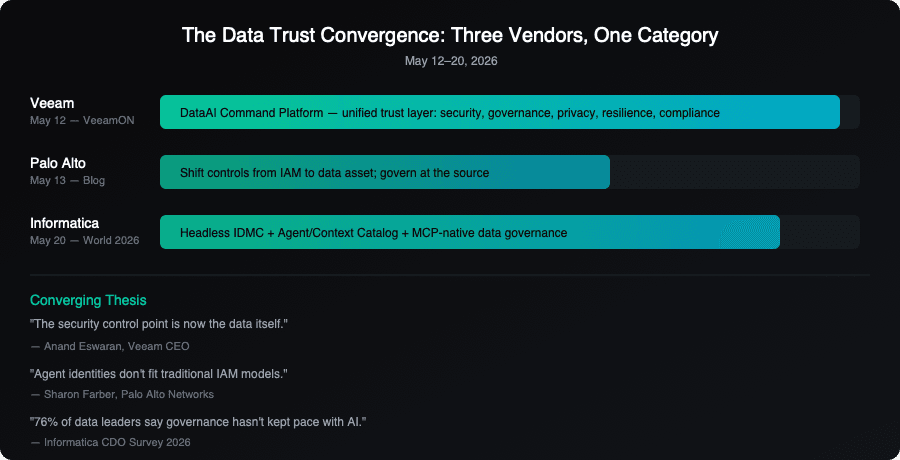
Veeam (May 12): The DataAI Command Platform converges data security, governance, compliance, privacy, and resilience into a single trust layer. Its DataAI Command Graph maps 300+ connectors across cloud, SaaS, and on-prem environments , identifying which specific files carry sensitive data, who has access, and what changes created risk conditions. Notably, governance is enforced at the data source, not at the agent. Whether an agent is sanctioned or rogue, it cannot access data that is governed at the source.
Palo Alto Networks (May 13): Sharon Farber's architectural guide argued that agent identities "don't fit traditional IAM models" because agents inherit shared service accounts and ephemeral credentials. Palo Alto's prescription: stop monitoring actors and start protecting the data asset directly. Policies should follow the data through every API endpoint, MCP server, and agentic workflow , regardless of who or what is accessing it.
Informatica from Salesforce (May 20): The first enterprise data management platform to ship fully headless data management with native MCP support. Any AI agent can invoke governance, data quality, and master data management capabilities through Model Context Protocol endpoints , from Claude, Slackbot, Cursor, and other frameworks. They also introduced what they call the industry's first unified "Agent and Context Catalog" to govern both data assets and AI agents from a single control plane.
Their CDO survey backs the urgency: 76% of data leaders acknowledge governance has not kept pace with AI, and 61% say higher-quality data makes it easier to move AI pilots into production.
The shared insight: security moves to the data layer
All three releases share a core architectural insight. Traditional security models assume human actors with stable identities performing trackable actions. AI agents break every one of those assumptions:
- Identity is unstable. Agents share service accounts, borrow credentials, and spin up as ephemeral instances that IAM systems weren't designed to govern.
- Speed outpaces oversight. An agent can browse the web, draft emails, call APIs, and move files between systems in seconds. The behavioral patterns that security tools detect lose their meaning when the actor isn't human.
- Privilege is excessive. Veeam's 97% figure isn't an outlier , it reflects that most organizations grant agents broader access than any human employee would receive.
The answer, all three vendors agree, isn't to build better agent monitoring. It's to move the control point from the actor to the data itself. When governance lives at the data layer, it doesn't matter whether the accessor is a sanctioned agent, a rogue agent, or a compromised system , the data protects itself.
What this means for SpringVanta buyers
If you're evaluating AI intake forms, voice agents, or lead qualification workflows, the data trust conversation is now a vendor evaluation question. Ask your AI vendors:
- Where does governance happen? At the agent level (easy to bypass) or at the data layer (enforced regardless of accessor)?
- How do you handle agent identities? If agents share credentials with humans, your audit trail is already broken.
- What's your data readiness posture? Before automating any workflow, can you verify that the data feeding it is fresh, classified, and access-controlled?
The vendors building the AI stack have started treating data trust as infrastructure, not an afterthought. If you're deploying AI agents in your business, your evaluation process should do the same.
Sources:
- Veeam Launches DataAI Command Platform (Business Wire, May 12, 2026)
- Veeam Data and AI Trust Maturity Model (Business Wire, May 12, 2026)
- Rethinking Data Security in the AI Era (Palo Alto Networks, May 13, 2026)
- Informatica Delivers the Trusted Data Foundation Every AI Agent Needs (Informatica, May 20, 2026)
- Informatica expands agentic AI strategy (SiliconANGLE, May 20, 2026)
- Fivetran 2026 Agentic AI Readiness Index (Fivetran, May 5, 2026)