Four Platforms Killed the Intake Form This Week
Typeform, Airia, Nitro, and Supio all shipped form-replacement features within 48 hours in May 2026. The data explains why: forms complete at 11%, AI conversations at...
By Springvanta
Between May 14 and May 15, 2026, four platform companies shipped features that share a thesis: the static intake form is done. Typeform launched Growth Flow, turning every form response into an automated lifecycle workflow. Airia shipped Form Review Step, adding human verification to AI document extraction for regulated industries. Nitro released Nitro Automate, embedding document processing into AI agents via MCP connectors. And Supio debuted Supio Agent with a built-in Intake Suite, the first end-to-end agentic platform for plaintiff law firms.
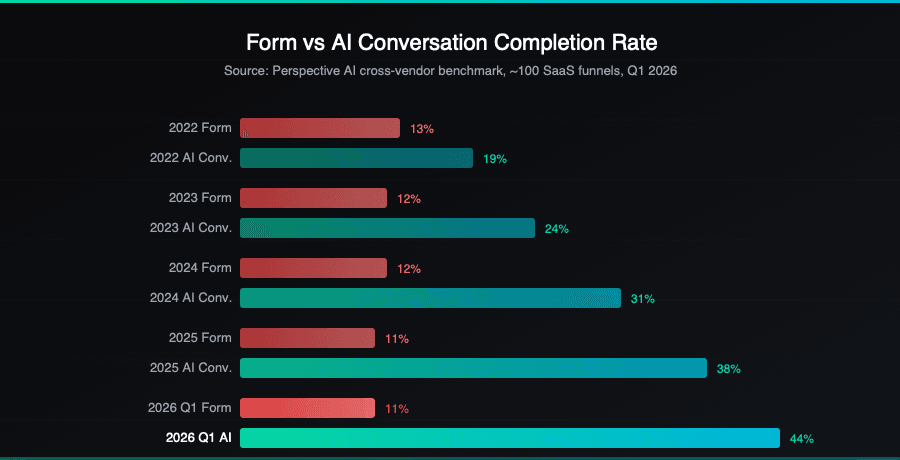
None of these companies coordinated. They arrived at the same conclusion independently because the data pointed one direction. Cross-vendor benchmarks from Perspective AI show B2B form completion sitting at 11% in Q1 2026, while AI conversation surfaces complete at 44%. That gap has grown from 1.5x to 4x in three years. When mobile B2B traffic crosses 71% of sessions, a 7-field form that works at 22% on desktop collapses to 8-10% on a phone screen.
Typeform stops being a form company
Typeform's Growth Flow launch on May 14 is the most market-visible signal. With 150,000 customers including 95% of the Fortune 500, Typeform built its business on forms. Now it calls itself an "AI engagement platform." Growth Flow connects lead capture, enrichment, nurturing, conversion, feedback, retention, and expansion in one platform. Typeform AI builds multichannel workflows from simple prompts, turning a single email address into enriched prospect context, then into routing, nurture campaigns, and next steps.
Aleks Bass, Typeform's Chief Product and Technology Officer, said it directly: "Typeform is no longer just a form builder, but the engine that turns responses into revenue and relationships." When the company that made forms famous starts calling them a starting point rather than the product, the category has shifted underneath everyone else.
Airia builds the checkpoint regulated industries need
Airia's Form Review Step, announced May 15, addresses a different layer of the same problem. AI models can extract data from deeds, mortgages, insurance claims, and vendor contracts, but regulated industries cannot let raw AI output enter their systems of record without human verification.
Form Review Step adds a split-screen interface where a reviewer sees the source document on one side and an AI-prefilled form on the other. Reviewers verify, correct, approve, or escalate. Every review creates a defensible audit trail: who approved, when, and what they changed. Airia CEO Kevin Kiley framed it plainly: "For documents that move money, title, or compliance, 'the model said so' is not a defensible standard."
This is the regulated-industry version of form replacement. The form does not disappear; it becomes a checkpoint between AI extraction and the system of record, with a human in the loop and an audit trail behind it.
Nitro puts document automation inside AI agents
Also on May 14, Nitro launched Nitro Automate, which processes thousands of documents in seconds and routes the output into any AI agent or workflow through MCP (Model Context Protocol) connectors. Sixty-seven percent of the Fortune 500 already uses Nitro for document workflows. The Automate launch embeds that document processing directly into CRM, ERP, and AI agent pipelines.
The significance: document intake, extraction, and routing are no longer separate tools. They are steps inside an agent workflow. For real estate brokerages processing listing agreements, law firms handling intake questionnaires, and healthcare practices managing patient onboarding forms, Nitro Automate turns the document into a structured signal that feeds the next agent action.
Supio brings intake into the agent platform
Supio's launch at SupioSphere on May 14 is the most vertically specific. Supio Agent is the first end-to-end agentic AI platform built for plaintiff law firms, and it includes a dedicated Supio Intake suite. The platform is HIPAA-compliant and integrates Thomson Reuters Westlaw Advantage for authoritative legal content.
For personal injury firms that lose leads to voicemail and missed calls, the Intake suite ensures every inbound call gets answered and qualified. The agent captures case details, runs initial assessment, and routes to the right attorney. This is not a chatbot bolted onto a form. It is intake built into the case management agent, with the case lifecycle starting at the first ring.
The convergence pattern
What makes these four launches notable is not any single product. It is that they attack the form from four different angles in the same 48-hour window:
- Typeform attacks from the platform side: the form becomes the trigger for an automated lifecycle, not the endpoint.
- Airia attacks from the compliance side: AI extraction gets a human checkpoint before the data becomes official.
- Nitro attacks from the infrastructure side: document processing becomes a step inside agent workflows via MCP.
- Supio attacks from the vertical side: legal intake is a feature of the case management agent, not a separate form tool.
The common thread: none of these companies are trying to make forms better. They are building what comes after forms.
What this means for service businesses
For law firms, healthcare practices, real estate brokerages, and any business that depends on intake, the pattern is clear. The vendors building the next generation of intake are not optimizing your contact form. They are replacing the form-response-then-wait pattern with a workflow that captures, qualifies, routes, and acts in one flow.
The data gap is hard to ignore. Forms complete at 11%. AI conversations complete at 44%. On mobile, where 71% of B2B traffic now arrives, forms that convert at 22% on desktop drop to single digits. Clio's 2023 Legal Trends Report found the average law firm fails to capture 64% of potential revenue from leads that never convert. In real estate, 78% of homebuyers work with the first agent who responds, but the average response time is measured in hours. In healthcare, 88% of appointments are still booked by phone, where 23-42% of inbound calls go unanswered.
The platforms that shipped this week are building for that gap. If your front door is still a 7-field form, the companies serving your industry just announced their plans to replace it.
Sources
- Typeform Growth Flow Launch, PR Newswire, May 14, 2026
- Airia Form Review Step Launch, GlobeNewswire, May 15, 2026
- Supio Agent Launch, PR Newswire, May 14, 2026
- The Conversion Gap Between Forms and Conversations Hit 4x in 2026, Perspective AI, May 2026
- Clio 2023 Legal Trends Report, Clio
- WildRun AI: AI Intake for Law Firms 2026, WildRun AI, May 14, 2026