Six Voice AI Platforms Shipped in Two Weeks: What Changed
Six platforms shipped production voice AI in two weeks. Zendesk, Salesforce, Yellow.ai, Twilio, Krisp, and Microsoft all moved past chatbot-era thinking in May 2026.
By Springvanta
Between May 5 and May 20, six major platforms shipped voice AI capabilities. Not chatbot plugins. Not demo-grade prototypes. Full production voice agents with multilingual support, CRM integration, and resolution workflows.
Zendesk launched its Autonomous Service Workforce on May 20, built on a Resolution Platform trained on roughly 20 billion ticket interactions. The centerpiece is Agent Builder, a no-code tool that lets companies create and deploy custom AI agents with their own policies and business logic. Zendesk's Voice AI Agents now support 60+ languages with mid-conversation language switching. The company also announced MCP support, a Context Graph for operational memory, and an outcome-based pricing model where charges apply only when a resolution is independently verified.
Two days earlier, Salesforce expanded Agentforce Voice with Hindi language support for the Indian market, covering 692 million Hindi speakers. The system handles natural code-switching between Hindi and Hinglish and performs action-oriented reasoning rather than just transcription. Earlier in May, Salesforce also added WhatsApp Voice to Agentforce Contact Center, tapping into WhatsApp's two billion active users.
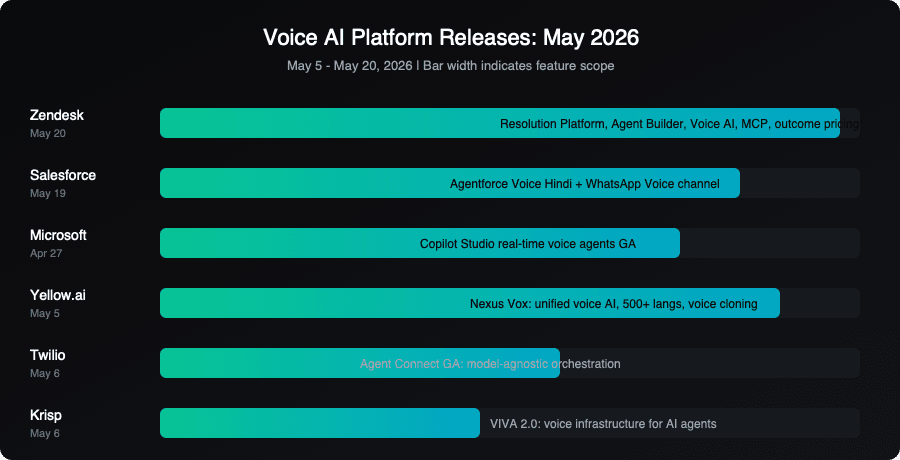
Yellow.ai announced Nexus Vox on May 5, calling it the first enterprise voice AI built as a single integrated system. Instead of stitching together separate speech recognition, voice synthesis, conversational AI, and telephony vendors, Nexus Vox runs everything in one runtime with what Yellow.ai calls "zero-hop architecture." It supports 500+ languages and can clone a brand voice from 10 seconds of audio. The enterprise voice AI market is projected to reach $47.5 billion by 2030, and Yellow.ai is positioning this as an answer to the latency and language coverage problems that have blocked adoption.
Twilio shipped Agent Connect for general availability on May 6, a model-agnostic orchestration layer that connects AI runtimes from OpenAI, Anthropic, Azure, Bedrock, or LangChain to Twilio's voice and messaging channels. The pitch is straightforward: integrate once, run any model, handle production voice complexities (barge-in, handoffs, session management) without writing glue code for each provider.
Krisp launched VIVA 2.0 the same week, addressing the infrastructure layer beneath voice AI agents. The SDK runs server-side before speech-to-text, handling background noise, detecting synthetic speech, identifying accents for better STT routing, and predicting when a caller has finished speaking. Krisp processes over 12 billion minutes of voice AI agent traffic per year and is embedded in 130+ voice AI products including Vapi, LiveKit, and Telnyx.
Microsoft made Copilot Studio real-time voice agents generally available in late April, extending its platform for over 80% of Fortune 500 companies already running Copilot agents.
What this means for businesses evaluating voice intake
This wave is not about voice quality getting better. That was the 2024 story. What changed in May 2026 is infrastructure maturity:
- Outcome-based pricing arrived. Zendesk's pay-for-verified-resolution model removes the incentive to deploy bots that deflect rather than resolve.
- Language coverage widened sharply. Yellow.ai at 500+ languages and Zendesk at 60+ with mid-call switching mean voice intake can now serve markets where English-language IVR was a non-starter.
- The stitched-stack problem got named and addressed. Yellow.ai's zero-hop architecture and Twilio's model-agnostic orchestration both target the latency and fragility that comes from bolting four vendors together.
- Voice AI got a pre-processing layer. Krisp's VIVA 2.0 handles the real-world audio problems (background noise, echo, accent variability) that make agents fail in production even when the LLM logic is correct.
For service businesses running intake on forms, phone queues, or stitched-together tools, the signal is straightforward: the major platforms are now competing on resolution rate and language coverage, not on demo polish. That shift makes it possible to evaluate voice AI against actual intake outcomes rather than vendor claims.
Sources
- Zendesk launches Autonomous Service Workforce - IT Brief Australia, May 20, 2026
- Salesforce expands Agentforce Voice with Hindi - Salesforce, May 19, 2026
- Agentforce Contact Center adds WhatsApp Voice - Salesforce, May 13, 2026
- Yellow.ai launches Nexus Vox - PRNewswire, May 5, 2026
- Twilio Agent Connect GA - Twilio, May 6, 2026
- Krisp launches VIVA 2.0 - Business Wire, May 6, 2026
- Quiq extends AI agent platform into voice - SiliconANGLE, May 11, 2026