Google Can Now Detect AI Content — And Its Core Update Demotes AI Spam
Google added AI content detection to Search and Chrome on May 19. Two days later, its core update demoted scaled AI content. Here's what changes for your website.
By Springvanta
On May 19, Google announced it's putting AI content detection directly into Search and Chrome. Two days later, it rolled out a core update that appears to be hammering low-quality AI-generated content in search results.
These are not coordinated announcements. Google's core update schedule and I/O don't sync up like that. But together, they clarify something that's been fuzzy for the past year: Google is building both the detection layer and the ranking signals to deal with AI-generated content at scale. If you publish content for your business, this is the week that changes how you should think about it.
What the core update is actually doing
The May 2026 Core Update started rolling out on May 21. Barry Schwartz covered it at Search Engine Roundtable. Google's official line is the same as every core update: "a regular update designed to better surface relevant, satisfying content." Two-week rollout. All languages. All regions.
What's different this time is what early data shows getting hit.
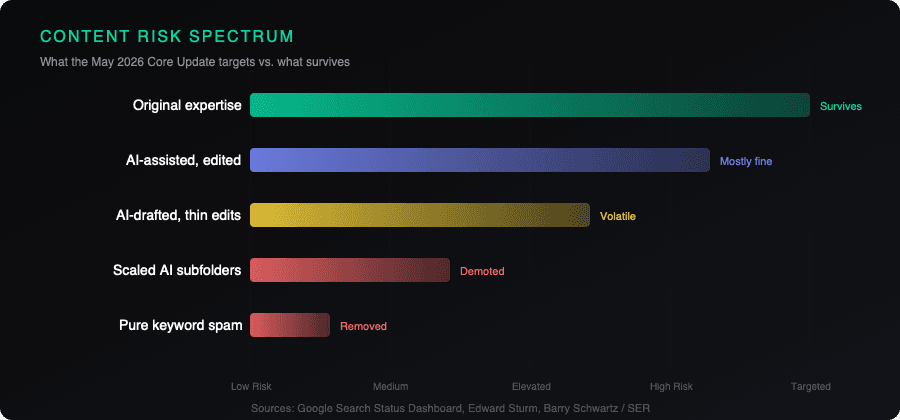
Edward Sturm documented a case where a large site's AI-generated blog subfolder effectively vanished from search results when the update landed. The English blog content was dense, repetitive, and clearly designed to capture search volume rather than answer questions. No original media. No clear expertise. Topic sprawl across dozens of loosely related subjects.
That pattern, the AI blog subfolder that exists purely to occupy keyword space, is exactly what Google appears to be targeting. Community reports from Reddit's r/digital_marketing and r/localseo confirm similar volatility across sites that rely on scaled AI content.
There's also a local SEO angle. Directory and aggregator sites are reportedly losing ground on "near me" queries. Google seems to be favoring the actual service provider over the middleman. If someone searches "plumber near me," Google is more inclined to show the plumber's Business Profile than a directory page listing twenty plumbers. That's been the direction for a while. This update sharpens it.
What SynthID in Search actually means
At I/O on May 19, Google announced it's expanding SynthID, its AI watermarking system, and C2PA Content Credentials directly into Search and Chrome.
Here's what that means in practice. You can now right-click an image in Chrome (or use Lens, Circle to Search, or AI Mode) and ask "Was this generated with AI?" and get an answer. Google says SynthID has already been applied to over 100 billion images and videos, plus 60,000 years of audio content. OpenAI, ElevenLabs, and Kakao are now adopting SynthID watermarks in their own tools.
This is a detection layer, not a ranking signal. Google is not saying "we'll demote content because SynthID detects it as AI-generated." The ranking changes in the core update are about content quality signals (usefulness, originality, expertise), not about whether an image carries an AI watermark.
But the two systems exist in the same ecosystem. When detection becomes trivial, when anyone can right-click and check, the incentive to pass off AI content as human drops. Users will check. Editors will check. Eventually, clients and customers will check. The infrastructure Google is building makes AI content transparency the default, not an optional disclosure.
What this means for your content strategy
If you run a business that publishes content (blog posts, service pages, case studies, landing pages), the implications are straightforward.
Don't build content programs around scaled AI generation. The sites getting hit in this core update are the ones that treated content as a volume play. AI-written blog subfolders with no expertise behind them, no original reporting, and no reason to exist beyond keyword occupancy. Google's ranking systems are getting better at identifying this pattern.
Do use AI tools to improve your content operations. There's a difference between using AI to draft, edit, and organize content (which is fine) and publishing hundreds of low-effort AI pages to capture search volume (which is getting penalized). The core update doesn't target AI usage. It targets low value. If your content reflects actual knowledge of your field, you're not the target.
Clean up any legacy AI content farms. If you have old blog sections built with bulk AI generation, this is a good time to audit them. Remove pages that don't say anything useful. Consolidate thin pages into stronger, more focused ones. Add original experience, data, or perspective.
Your FAQ schema still works (for now). In a separate but related change, Google killed FAQ rich results on May 7. The expandable Q&A dropdowns under search listings are gone. But FAQPage structured data is still valid markup. Bing, Perplexity, ChatGPT, and other AI search systems still parse it. Don't remove it. Just know that it no longer produces a visual SERP feature in Google. Joost de Valk wrote a sharp piece on why FAQ schema kept dying, and it's worth reading if you want to understand the pattern.
Local businesses may be gaining ground. If you run a local service business, the directory demotion in this update could benefit you. Make sure your Google Business Profile is complete, your site has clear service area and contact information, and your pages match the intent behind "near me" searches.
The broader pattern
Google is building on two fronts at once. On one side, it's giving users the ability to verify whether content is AI-generated. On the other, it's refining ranking signals to reward content that demonstrates genuine expertise and penalize content that doesn't.
Neither of these is new. But both are accelerating. The May core update and the SynthID expansion arriving in the same week is coincidental timing. The direction is not.
For businesses investing in AI automation, the takeaway is simple: use AI to run your operations, handle intake, manage your CRM, automate your workflows. Use it to make your content better, not just more abundant. The tools for detecting and demoting low-effort AI content are getting better every month. The content that survives is the content that knows something.
Sources:
- Barry Schwartz, "Google May 2026 Core Update Is Rolling Out," Search Engine Roundtable, May 21, 2026
- Edward Sturm, "AI Spam Gets Smoked, Local SEO Shifts, GSC Breaks," YouTube, May 24, 2026
- Google Blog, "Making it easier to understand how content was created and edited," May 19, 2026
- MWM, "Google Expands AI Content Detection to Chrome and Search in May 2026," May 20, 2026
- Joost de Valk, "FAQ schema died twice. The fix is FAQSection," joost.blog, May 11, 2026
- SEO Strategy, "FAQ Schema After 7 May 2026: What Actually Changed," May 9, 2026