Google puts links back in AI search: what the May 6 update changes
Google added inline links, hover previews, and subscription labels to AI Overviews on May 6. Here is what the data says about the click crisis and what it means for your site.
By SpringVanta
On May 6, Google announced five changes to AI Overviews and AI Mode. More links placed inside AI-generated answers. Hover previews on desktop. A "Subscribed" label on links from news outlets you pay for. Named creator citations from Reddit, forums, and social posts. A new section at the end of each AI response with suggested articles to read next.
Google framed these as improvements to web discovery. Hema Budaraju, VP of Product Management for Search, said the goal is to make it easier for people to "connect with authentic voices and explore useful information across the web."
Read between the lines and the picture is different.
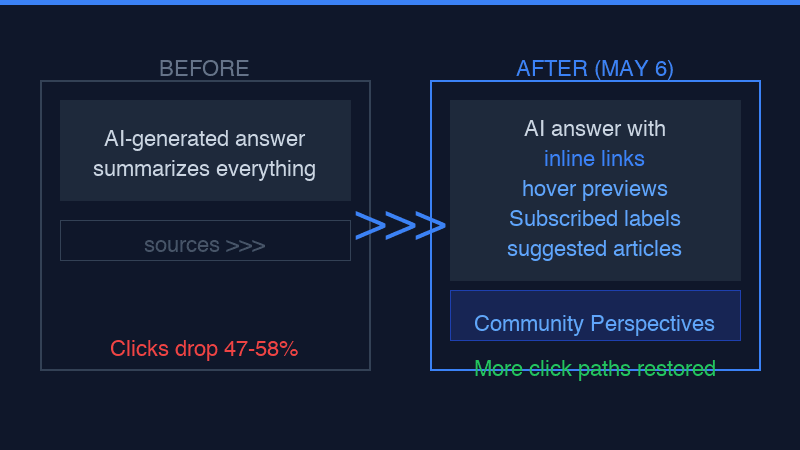
The link updates are a reaction to pressure, not a feature launch. That context matters for deciding what to do about them.
What the click-loss studies show
Three separate analyses, using different methods, arrive at similar conclusions.
Ahrefs measured roughly 300,000 keywords in February 2026 and found a 58% lower click-through rate on the top-ranking page when an AI Overview appeared above it. Pew Research ran a study of 68,879 searches across 900 US adults and measured an 8% click rate on pages with AI Overviews versus 15% without. Seer Interactive tracked 3,119 keywords and 25.1 million impressions over eight months. CTR dropped from 1.76% to 0.61% before partially stabilizing.
Chartbeat reported a 33% decline in search-engine referrals across more than 2,500 news sites worldwide.
These are not small sample sizes. They describe a measurable shift in how people interact with Google when an AI-generated answer sits at the top of the page.
The five changes, and what each one does
Inline links next to cited text. Previously, source links sat in a separate bar below the AI answer. Now they appear directly beside the sentences they support. The change reduces friction between reading and clicking, though it does not change the fact that the answer itself is already on the page.
Hover previews on desktop. Hovering over an inline link shows the site name and page title. This is a trust signal. People can decide whether to click before committing, which should improve click quality even if it does not raise volume.
Subscription labels. Links from publications you subscribe to get a "Subscribed" badge. Google says early tests showed people were "significantly more likely" to click those labeled links. For publishers behind paywalls, this is the most directly useful change.
Named creator citations. When an AI response pulls a quote from Reddit, a forum, or a social post, the original creator's name and handle appear alongside it. For brands building community presence, this makes the attribution chain visible in a way it was not before.
Suggested articles at the end. A new section surfaces deeper coverage on related angles. Google's example shows a query about urban green spaces producing links to reports about New York and Singapore. For content that goes deep on a topic, this is a new entry point into AI answers.
What the March 2026 core update tells us about AI citation
The May 6 link update is a surface-level change. The deeper signal came from the March 2026 core update, which ran from March 27 through April 8 and produced roughly 80% churn in top-three search results, the highest volatility ever recorded for a core update.
According to analysis by Aleyda Solis and data from Amsive tracking 2,000+ US domains, the winners were official sources, specialist sites, and established brands. Aggregators, directories, and comparison sites lost ground. YouTube lost 567 SISTRIX visibility points in a single update cycle.
For AI Overview eligibility specifically, BlogPros reported that pages cited inside AI answers now earn roughly 35% more clicks than traditional first-page rankings. But eligibility criteria tightened after March. Pages missing Core Web Vitals thresholds became measurably less likely to appear. Health, finance, and e-commerce content lost AI Overview visibility, while niche expert sites and educational content gained.
Seer's April 2026 data adds one more piece: brands cited in AI Overviews get roughly 120% more organic clicks per impression than non-cited competitors on the same query. Being inside the AI answer is not just a vanity metric. It has a compounding effect on traffic.
What to do this week
If you run a business that depends on search visibility, the May 6 update is a reminder that citation inside AI answers is now a distinct optimization target, separate from traditional ranking. Here are the practical steps that align with both the March core update signals and the May link changes.
Segment your Search Console data. Google Search Console now lets you filter by Search Appearance for AI Mode and AI Overviews. Check which of your pages appear in AI answers and which do not. The gap between your traditional rankings and your AI citation rate is the first thing to diagnose.
Write citation-ready answer blocks. AI systems pull short, self-contained claims. Structure your content so that definitions, steps, comparisons, and key statistics appear in the first 50-70 words of a section, not buried 800 words into a page.
Clean up your schema markup. Structured data is one of the three signals AI citation systems evaluate. Article schema, FAQPage schema, and Organization schema all help models interpret what your page is about and who is behind it.
Strengthen E-E-A-T signals. Author attribution, credentials, editorial oversight, and original data are the trust signals that AI answer engines use to decide whether to cite your content. The March core update rewarded exactly these signals.
Track brand search volume. As AI answers compress traditional click-through, branded search becomes a proxy for whether people encounter your name inside an AI response and then search for you directly.
Think beyond Google. ChatGPT, Perplexity, and Gemini each cite sources differently. A 2026 study from Growth Memo found that 24% of ChatGPT responses are generated without fetching any online content, and Gemini provides no clickable citation in 92% of responses. Your content strategy needs to account for platforms that may never send you a click but will shape whether people find you at all.
Sources
- Google updates links within AI Overviews & AI Mode — Barry Schwartz, Search Engine Land, May 6, 2026
- AI Overviews Are Killing Clicks — Christian Ott, SEO Kreativ, May 10, 2026
- Google Says A New Wave Of AI Users Is Transforming Search — Roger Montti, Search Engine Journal, May 5, 2026
- Google AI Overviews Will Now Show More Source Links — Technology.org, May 11, 2026