Governance Is the Bottleneck: Why AI Agent Adoption Has Outpaced Control
Six independent surveys from 2026 reveal the same structural problem: enterprises are scaling AI agents faster than they can govern them. The data paints a clear pictu...
By Springvanta
Six new surveys landed in the first half of 2026, and they all tell the same story: enterprises are deploying AI agents at full speed while the governance layer is still being sketched on whiteboards.
The numbers are stark. Credo AI surveyed 371 senior leaders and found that 60% of enterprises are scaling AI across multiple departments, yet only 4% have governance mature enough to keep up. That 15:1 ratio is the widest adoption-control gap measured so far.
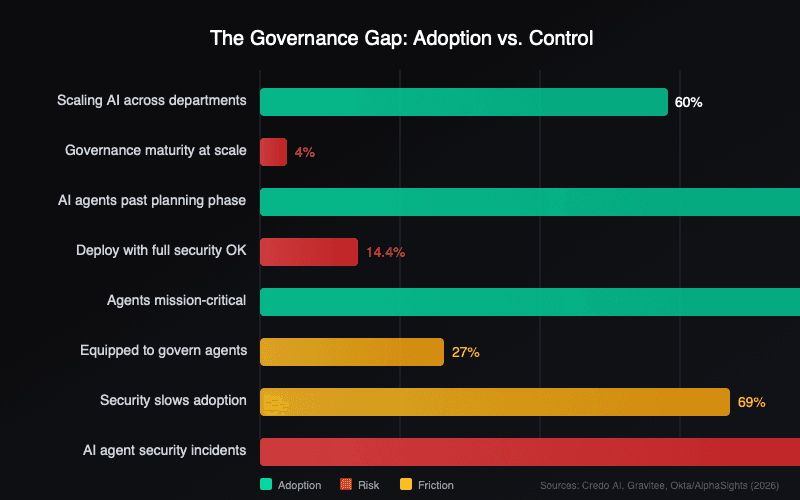
Then Gravitee polled over 900 executives and technical practitioners for its State of AI Agent Security 2026 Report. The result: 80.9% of technical teams have moved past planning into active testing or production with AI agents. But here is the kicker: only 14.4% report that all AI agents go live with full security and IT approval. The rest ship with partial, inconsistent, or no security review at all.
Security incidents are no longer theoretical
This is not a future risk. It is a present cost. Gravitee found that 88% of organizations reported confirmed or suspected AI agent security incidents in the past year. In healthcare, that figure climbs to 92.7%.
Darktrace's State of AI Cybersecurity 2026 report reinforces the concern: 92% of security professionals say they are worried about the impact AI agents will have on their organization's security posture. This is not vendor FUD. This is the consensus of the people responsible for stopping breaches.
The incidents are real and range from agents gaining unauthorized write access to production databases, to attempts at exfiltrating sensitive information through agent-mediated API calls. When a quarter of deployed agents (25.5%, per Gravitee) can create and task other agents, the chain of accountability becomes nearly impossible to trace.
The confidence paradox
Perhaps the most dangerous finding is the gap between perception and reality. Okta commissioned AlphaSights to survey 150 IT and security decision-makers in January 2026. The result: 86% called AI agent workflows "very important" or "mission-critical" to their strategy. Yet only 27% agreed that their current identity systems are fully equipped to govern these non-human identities at scale.
Gravitee found a similar pattern: 82% of executives feel confident their existing policies protect against unauthorized agent actions. The practitioners on the ground see something very different. Most organizations still treat agents as extensions of human users or generic service accounts. When agents share credentials, accountability breaks down entirely.
Governance is now the deployment gate
Here is the shift that matters for anyone building or buying AI tools: governance has moved from a compliance checkbox to a deployment bottleneck.
Okta's survey found that 69% of organizations say security concerns are actively slowing AI agent adoption. Zapier's governance report, based on 200 enterprise executives, found that 93% say governance challenges are blocking AI from reaching production. That is not a gap. That is a wall.
The buyer behavior data confirms this is not just talk. Okta found that 98% of SaaS decision-makers will factor AI agent security controls into their renewal decisions, with 17% calling it a "significant requirement." If your product handles AI agents and lacks governance controls, you are already losing deals.
What changes for operators
For SMB and mid-market operators considering AI automation, these findings reshape the calculus:
Start with identity, not features. The number-one barrier cited across multiple surveys is over-privileged access and data leakage. Before deploying any AI agent, ask whether it has its own identity, scoped permissions, and an audit trail. If the answer is "it uses our API key," that is a red flag.
Demand standardized protocols. Okta found that 95% of organizations say a standardized protocol like Cross App Access (XAA) would improve their confidence in deploying AI. The market is converging on interoperable security standards. Vendors who adopt them early will win. Those who do not will face procurement rejection.
Audit what you already have. Shadow AI is not coming. It is already here. Credo AI's report flagged incomplete AI inventories and manual workflows as the top operational barriers to governance. If you have not inventoried every AI tool and agent currently running in your organization, you cannot secure it.
Treat data readiness as a prerequisite. Governance without clean, structured data is theater. Before layering agent governance on top of CRM or intake workflows, make sure the underlying data can support the automation you are planning. Garbage in, governance out.
The bottom line
The 2026 data from Credo AI, Gravitee, Darktrace, Okta, Zapier, and others converges on one conclusion: governance is no longer trailing adoption by a little. It is trailing by a lot. And that gap is now the primary constraint on enterprise AI value.
For SpringVanta buyers evaluating AI intake, voice agents, or adaptive forms, the question is no longer "can AI do this?" It is "can I govern, audit, and secure AI doing this?" If the vendor cannot answer yes with specifics (not roadmaps), keep looking.
Sources:
- Credo AI, The State of AI Governance (2026) , 371 senior leaders surveyed
- Gravitee, State of AI Agent Security 2026 , 900+ executives and practitioners
- Darktrace, State of AI Cybersecurity 2026 , global security professionals
- Okta/AlphaSights, Enterprise Buyer Survey: AI Agent Security (Jan 2026) , 150 IT/security decision-makers
- Zapier, The Future of AI Governance in 2026 , 200 enterprise executives and practitioners