$1.5B, AI Agents, and 85% Client Pressure: Vertical AI Intake Week
Three signals in one week: DocuSign shipped contract agents, Blackstone put $1.5B behind AI deployment, and 85% of law firms feel client pressure on AI strategy.
By Springvanta
Three things happened in the same week of May 2026 that tell you where vertical AI intake is headed. None of them are subtle.
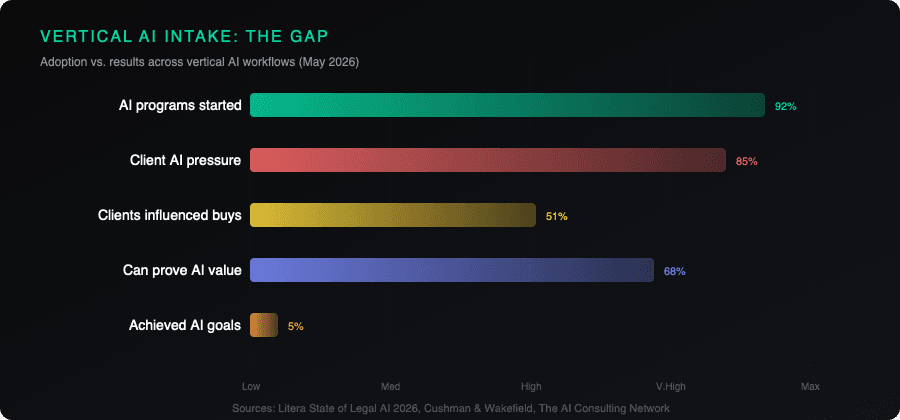
DocuSign launched AI agents that negotiate contracts. Blackstone and Anthropic put $1.5 billion behind a firm that embeds AI into mid-market operations. And Litera's State of Legal AI report found that 85% of law firms feel direct client pressure on their AI strategy, with 51% saying a client has already influenced an AI purchase decision in the last year.
These are not separate stories. They are the same story from three angles: the tools shipped, the money showed up, and the buyers started demanding results.
DocuSign bets on agents, not copilots
On May 21, DocuSign announced Iris, an AI engine for agreement workflows, plus a set of reusable agents and a low-code Agent Studio. The pitch is specific: domain-specific agents that understand contract language, can check agreements against company standards, suggest edits, and trigger approvals. IAM for Sales shipped globally that day. IAM for HR enters early access in June. AI-assisted Web Forms, which generate contract forms from context, go global in June too.
What makes this different from yet another AI feature drop is the scope. DocuSign is not adding a chatbot to its e-signature product. It is repositioning as an agreement management platform where AI agents handle the full lifecycle: draft, review, negotiate, execute, and monitor. The Agent Studio lets customers build custom agents without writing code, which is the same playbook Salesforce used to lock in enterprise accounts.
The risk is real. If an agent hallucinates a clause or misreads a compliance requirement, the consequence is not a bad email draft. It is a blown deal or a regulatory violation. DocuSign has not published detailed data governance specs yet, which will be a problem for regulated verticals like healthcare and finance. But the direction is clear: contract workflows are the next intake battleground.
$1.5 billion says the bottleneck is implementation, not models
The same day DocuSign shipped its agents, Blackstone, Anthropic, Hellman & Friedman, and Goldman Sachs announced a combined $1.5 billion commitment to an unnamed AI-native enterprise services firm. Anthropic, Blackstone, and Hellman & Friedman each put in $300 million. Goldman Sachs added $150 million. Apollo, GIC, General Atlantic, Leonard Green & Partners, and Sequoia Capital filled out the round.
The firm's first move was acquiring Fractional AI, a San Francisco applied engineering team that deploys Claude inside live workflows. The plan: embed AI into Blackstone's own portfolio companies first (spanning healthcare, real estate, financial services, manufacturing, and retail), then expand to the broader mid-market.
The signal here is not the technology. It is who is paying. Blackstone is the world's largest commercial real estate owner, with over $1.3 trillion in assets under management. They are treating AI deployment as portfolio strategy, not experimentation. According to research cited by the firm, 92% of corporate occupiers have started AI programs, but only 5% report achieving most of their goals. Blackstone is betting the bottleneck is implementation, not the model.
This is not happening in a vacuum. On May 11, OpenAI launched its own $4 billion deployment company co-led by TPG, Advent, Bain Capital, and Brookfield. On May 19, KPMG signed a global alliance with Anthropic, embedding Claude across its 276,000-person workforce. The implementation layer is consolidating fast, funded by the same capital that owns the buildings and the client relationships.
The client pressure is no longer theoretical
Litera's State of Legal AI: Spring 2026 Market Sentiment Report, published through the relaunch of The Changing Lawyer, adds the demand-side data point. 85% of law firms report feeling or expecting direct client pressure on their AI strategy. 51% say a client has directly influenced an AI investment decision in the past 12 months. Only 15% describe their AI investment as still entirely internally driven.
The gap that matters: 32% of firms cannot confidently demonstrate AI value to their most important client. When asked what will differentiate their firm when every competitor has access to the same AI, respondents pointed to people and expertise (24%), custom workflows (18.7%), and proprietary data (13.3%). Not technology. The firms that win will be the ones that can show clients how AI changed their intake process, not the ones that bought the most expensive model.
As Casey Flaherty, B+B Partner and Head of LexFusion Intelligence at Baretz+Brunelle, put it: "Client pressure is no longer theoretical, and firms are right to focus less on model access than on operational execution. In this market, unarticulated value is invisible value."
What this means for intake automation
If you run intake for a legal practice, healthcare clinic, or real estate brokerage, these three signals tell you something concrete. The tools are shipping fast: DocuSign's agents handle contract negotiation, Anthropic's legal plugins manage document workflows, and platforms like LAW.co are deploying private AI infrastructure for intake automation. The money is there: $1.5 billion from Blackstone says implementation is now a funded discipline, not a hobby. And the clients are asking: 85% of legal firms feel the pressure, and the same dynamic is spreading to healthcare intake and real estate lead qualification.
The practical move is to stop running AI experiments and start treating intake automation as a workflow redesign problem. Pick two or three high-friction points in your intake process, such as form completion, document collection, or lead scoring, and rebuild them around what current AI agents can actually do. Keep a human in the loop on every consequential output. Measure the time saved and the error rate. Then show the results to your clients or partners before they ask.
The firms that win this cycle will not be the ones with the most pilots. They will be the ones that turned AI intake into something their clients can see and feel.
Sources
- DocuSign Unveils AI Assistant and Agents (DocuSign IR, May 21, 2026)
- Blackstone and Anthropic Launch AI Enterprise Services Firm (AI Consulting Network, May 21, 2026)
- Litera Releases State of Legal AI 2026 Report (Digital IT News, May 22, 2026)
- DocuSign's New AI Agents Will Negotiate Contracts For You (Smart Chunks, May 23, 2026)
- How In-House Teams Are Using AI Agents (Law.com, May 19, 2026)