Voice AI Goes Self-Serve: Four Platforms Open Their Doors in One Week
PolyAI, Kore.ai, Crescendo, and EngageLab all opened voice AI platforms this week. Enterprise voice AI is now self-serve, governance-controlled, and flat-rate.
By Springvanta
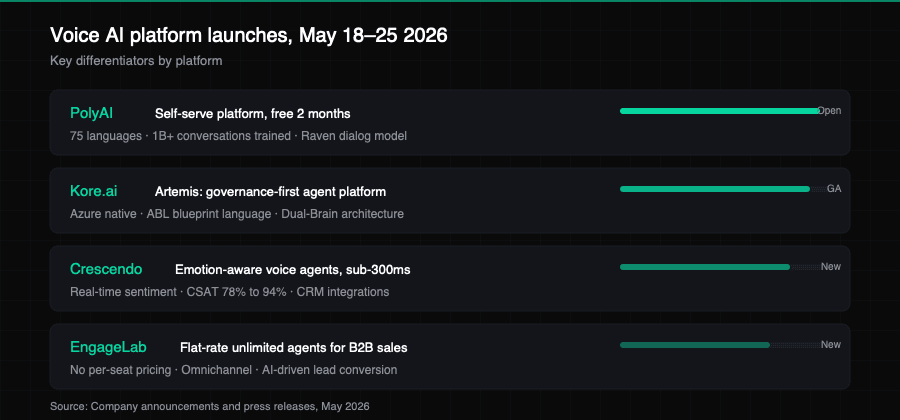
Four voice AI platforms made the same move this week, and it was not a coincidence. PolyAI opened its enterprise dialog platform to anyone with an email address. Kore.ai shipped a governance-first agent platform called Artemis. Crescendo launched emotionally intelligent voice agents with sub-300ms response times. And Aurora Mobile's EngageLab introduced flat-rate "unlimited agents" pricing for B2B sales.
One week. Four companies. The same bet: voice AI is done being an enterprise-only club.
PolyAI: Enterprise voice AI, now with self-checkout
PolyAI spent a decade building conversational agents for Marriott, FedEx, PG&E, UniCredit, and Caesars Entertainment. On May 18, the company opened its Agentic Dialog Platform to anyone. Two months free, no sales call required.
The platform runs on Raven, a proprietary dialog model trained on more than a billion enterprise conversations. Co-founder and CTO Shawn Wen described the approach as having "agent harness in the weights, not bolted on through prompts that drift under pressure." Builders get two paths: Poly Agent Builder (describe your use case, get a production agent in 10 minutes) or an Agent Development Kit for developers who want to work in their own IDE with Git versioning.
This is the same infrastructure that handles gas leak calls for utilities and payment disputes for banks. The largest deployments do the work of 1,000+ full-time employees per enterprise, according to the company. Now any team can build on it.
Kore.ai Artemis: Governance as architecture
On May 21, Kore.ai launched the Artemis edition of its agent platform, and the pitch is aimed squarely at CIOs and CISOs who have been blocking AI deployments over compliance concerns.
Three innovations ship with it. Agent Blueprint Language (ABL), a compiled declarative language for defining and validating agents. Arch, an AI that translates business objectives into production-ready ABL. And a Dual-Brain Architecture that runs agentic reasoning and deterministic flows in parallel through shared memory.
The claim: enterprises can deploy production-ready multi-agent systems in days rather than months, with every decision logged, traced, and auditable. The platform integrates with Microsoft Foundry, Agent 365, Entra ID, and Teams. It ships with SOC 2 Type II, ISO 27001, PCI DSS, FedRAMP Moderate, and HIPAA alignment.
For businesses in regulated industries (banking, healthcare, insurance), this is the "finally" moment. Kore.ai says 500+ Global 2000 organizations already use their software. The Artemis edition makes the governance piece architectural rather than something you bolt on after the fact.
Crescendo: Emotion-aware voice agents
Crescendo's launch on May 24 targets a different gap: voice AI that actually sounds human. The platform delivers sub-300ms response times and adjusts tone based on real-time sentiment analysis. If a caller is frustrated, the agent shifts to a more empathetic register.
Early deployment numbers: CSAT scores climbing from 78% to 94% in one case. A clinic that replaced its IVR saw call abandonment drop 65% and appointment bookings rise 40%. The platform supports long-term memory across interactions and integrates with Salesforce, HubSpot, and Zendesk.
The catch is pricing. It follows an enterprise custom-quote model, and non-English voice quality is still maturing. But the performance metrics are real, and the CRM integrations mean this is not just a demo tool.
EngageLab: The pricing disruption
Aurora Mobile's EngageLab launched its AI-powered Conversational Sales Solution on May 25 with a model that breaks the SaaS per-seat convention: unlimited support agents for a flat fee.
The product combines omnichannel aggregation with AI-driven collaboration for B2B lead conversion. The argument is direct: the traditional funnel (content, forms, CRM, sales callback hours later) is broken. One client reportedly covered 37.5% of system costs in the first week.
Whether that figure holds up across deployments is unclear, but the pricing model itself is the story. Per-seat pricing for AI agents has been a persistent complaint from buyers. EngageLab is the first major platform to remove it entirely for conversational sales.
The pattern
These four launches share a trajectory. Voice AI platforms are moving from "request a demo" to "start building now," from per-seat to flat-rate, and from generic synthetic voices to branded, emotionally aware, governance-controlled agents.
Six months ago, deploying a production voice agent meant an enterprise contract, professional services, and months of setup. This week, PolyAI put the same infrastructure behind a signup form. If your voice AI vendor still requires a demo call and a per-seat contract, it may be time to see what else is out there.
Sources:
- PolyAI opens Agentic Dialog Platform (PR Newswire, May 18, 2026)
- Kore.ai launches Artemis agent platform (Kore.ai, May 21, 2026)
- Crescendo emotionally intelligent voice agents (Complete AI Training, May 24, 2026)
- Aurora Mobile EngageLab Unlimited Support Agents (Business Insider / GlobeNewsWire, May 25, 2026)
- CMSWire: PolyAI opens enterprise dialog platform (CMSWire, May 18, 2026)